
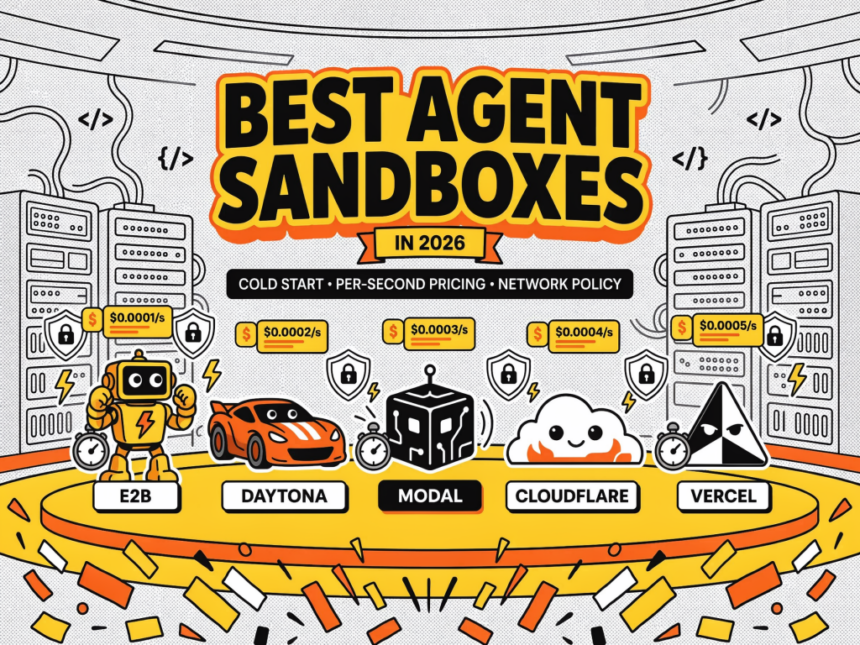
For modern software agents, the ability to write and execute code is the baseline of intelligence. What began as a niche requirement has evolved into a critical infrastructure category featuring a variety of vendors, disparate billing models, and marketing benchmarks that are rarely comparable. This analysis provides a structured, objective breakdown of the current landscape, focusing on the platforms that define the market: E2B, Daytona, Modal, Cloudflare, and Vercel.
The Four Pillars of Agentic Sandboxing
Marketing literature often glosses over the architectural realities of these platforms. To make an informed infrastructure choice, developers must focus on four fundamental properties:
- Cold Start Under Concurrency: An agent that initializes a new sandbox for every tool invocation encounters this latency thousands of times daily.
- Filesystem Persistence: Whether the environment retains state between turns dictates if the agent can effectively manage long-running tasks or package installations.
- Egress Policy: This defines the sandbox’s relationship with the public internet, the granularity of control available, and the ability to modify access mid-session.
- Idle Billing: Because agents spend significant time waiting on LLM inference, the idle billing policy determines who pays for that inactivity.
Benchmarking Performance: Real-World Latency
Generic vendor claims are often misleading. A more rigorous approach involves measuring Time to Interactive (TTI), which tracks the interval from the creation API call to the successful execution of the first command within the sandbox. The following table represents performance data from a concurrent burst load (100 iterations) on a 4 vCPU host in Northern Virginia, as of August 21, 2026.
| Provider | Median TTI | P95 | P99 | Success Rate |
|---|---|---|---|---|
| Vercel Sandbox | 0.67s | 1.04s | 1.12s | 100% |
| Modal | 0.88s | 1.00s | 1.08s | 100% |
| Runloop | 0.89s | 3.27s | 3.50s | 100% |
| E2B | 1.61s | 1.77s | 1.81s | 100% |
| Cloudflare | 5.06s | 6.04s | 6.48s | 100% |
| Daytona | 0.27s | 0.43s | 0.44s | 37% |
The high tail-latency in several platforms highlights why median performance is insufficient for design decisions. Furthermore, success rates are critical; a fast median that only succeeds 37% of the time necessitates robust, built-in retry logic in any production agent loop.
Economic Efficiency: Rate Cards vs. Actual Costs
To understand real-world expenditure, we must normalize pricing. While headline rates vary, they often conceal the difference between wall-clock billing and active-CPU usage.
| Platform | CPU Rate | Memory Rate | Billing Model |
|---|---|---|---|
| E2B | $0.0504 / vCPU-hr | $0.0162 / GiB-hr | Wall-clock |
| Daytona | $0.0504 / vCPU-hr | $0.0162 / GiB-hr | Wall-clock |
| Modal | $0.0710 / vCPU-hr | $0.0240 / GiB-hr | Max(request, actual) |
| Vercel | $0.128 / vCPU-hr | $0.0212 / GB-hr | Active-CPU usage |
| Cloudflare | $0.072 / vCPU-hr | $0.009 / GiB-hr | Active-CPU + provisioned |
When modeling an agent workload, the billing model is frequently more influential than the unit cost. Platforms using active-CPU billing become significantly more economical for idle-heavy workloads, where the agent spends long durations awaiting model inference.
Network Security and Credential Management
Beyond network blocking, the primary security concern is how platforms handle credentials. Cloudflare handles outbound requests via handlers running in the Workers runtime, outside the sandbox, which allows for robust binding access. Vercel utilizes a firewall on the host, outside the microVM, to broker egress requests. E2B offers proxy-based request transforms that inject headers at the network layer, preventing the sandbox from ever seeing sensitive identity tokens. These architectural choices for secret management are essential for agents that handle untrusted inputs.
Strategic Platform Selection
- Vercel Sandbox: Ideally suited for agentic loops with high model-wait times, benefiting from an active-CPU billing model and a highly consistent performance distribution.
- E2B: The choice for developers requiring per-session kernel isolation, state persistence across turns, or the ability to self-host the underlying infrastructure.
- Modal: Necessary for workflows that demand hardware-accelerated computation, offering a comprehensive GPU rate card directly within the sandbox.
- Cloudflare: Best for developers already operating in the Workers ecosystem, leveraging egress handlers that offer superior security for sensitive API calls.
- Daytona: Architected for users who prioritize long-lived, persistent development environments with flexible stop/pause lifecycle management.