
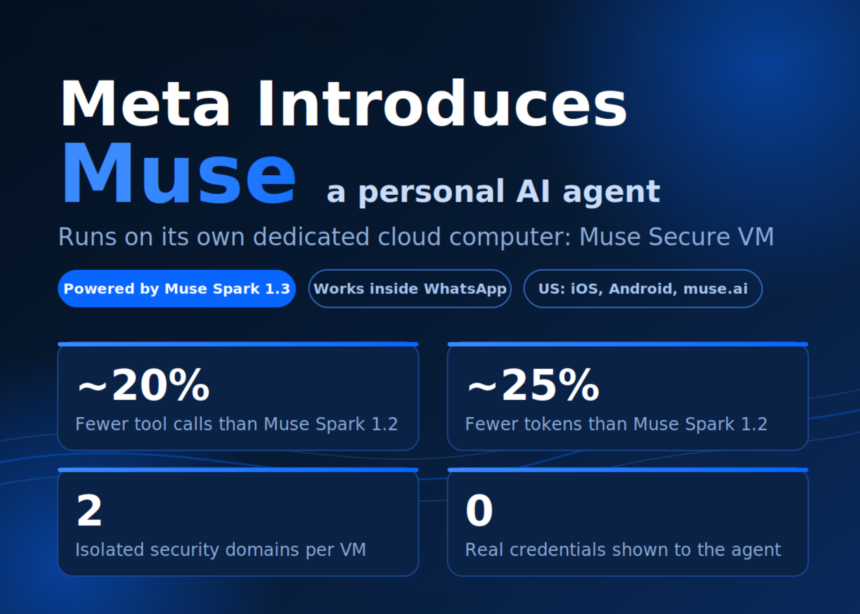
The recent unveiling of Meta’s Muse AI agent marks a pivotal shift in how we conceive of personal, autonomous computing. While many AI models act as conversational interfaces, Muse is fundamentally an actor—designed to navigate the web, manipulate interfaces, and manage complex tasks that persist long after the user has logged out. However, the true technical breakthrough lies not just in its intelligence, but in its isolation architecture.
The Architecture of Personal AI
To ensure safety and privacy, Meta has moved away from the traditional shared-compute model for agents. Instead, every user interaction is tethered to a Muse Secure VM, a dedicated cloud-based virtual machine. This architecture solves the most persistent problem in agentic AI: how to allow an agent to browse the web and store local state without exposing the user’s primary credentials or environment to exploitation.
The system relies on a multi-tiered security framework:
- Runtime Cells: The agent operates within a
systemd-nspawncontainer, where kernel capabilities are strictly limited and system calls are filtered. - Sentinel Oversight: A secondary, isolated agent—the Sentinel—manages all permissions. Muse makes requests, but the Sentinel must authorize every network egress and sensitive action at both Layer 4 and Layer 7.
- Surrogate Credentialing: Rather than exposing real passwords, the VM uses surrogate tokens. Real secrets are injected only at the network boundary, ensuring that even a successful prompt injection cannot leak persistent credentials.
- Accessibility Modeling: The agent’s browser sub-component parses an accessibility tree rather than raw DOM, preventing malicious actors from executing arbitrary JavaScript or intercepting sensitive form data.
Performance and Model Capabilities
Powering this agent is Muse Spark 1.3, a model engineered specifically for long-horizon planning and tool execution. By optimizing the model to handle zero-shot CLI tool calls and multi-workflow threading, Meta has significantly reduced the overhead associated with complex autonomy.
| Metric | Performance Improvement (vs. Muse Spark 1.2) |
|---|---|
| Tool Call Efficiency | ~20% reduction in calls required |
| Token Consumption | ~25% reduction in total tokens |
Security as a Structural Requirement
The most compelling aspect of the Muse design is the use of eBPF taint tracking. This technology distinguishes between requests that originate from trusted user input and those that arise after the agent has touched external, untrusted web data. By gating actions based on this tracking, Meta creates a structural barrier against prompt injection that does not rely solely on the model’s training.
Furthermore, the email connector within the Muse ecosystem is pre-configured to strip out password reset links and one-time passcodes, mitigating the risk of account takeovers. This approach demonstrates a move toward secure-by-default architecture, where the infrastructure is as responsible for safety as the underlying neural network.
Integration and Availability
Muse is currently available as a consumer-facing service on iOS, Android, and the web. While end-users cannot self-host the secure VM environment, developers have access to the model itself:
- Meta Model API: Direct access to Muse Spark 1.3 for building custom agentic workflows.
- Muse Code: An interface for developers to prototype agent behaviors.
- Roadmap: Meta has committed to an open-weights release, promising to bring this level of agentic capability to the broader developer community.