
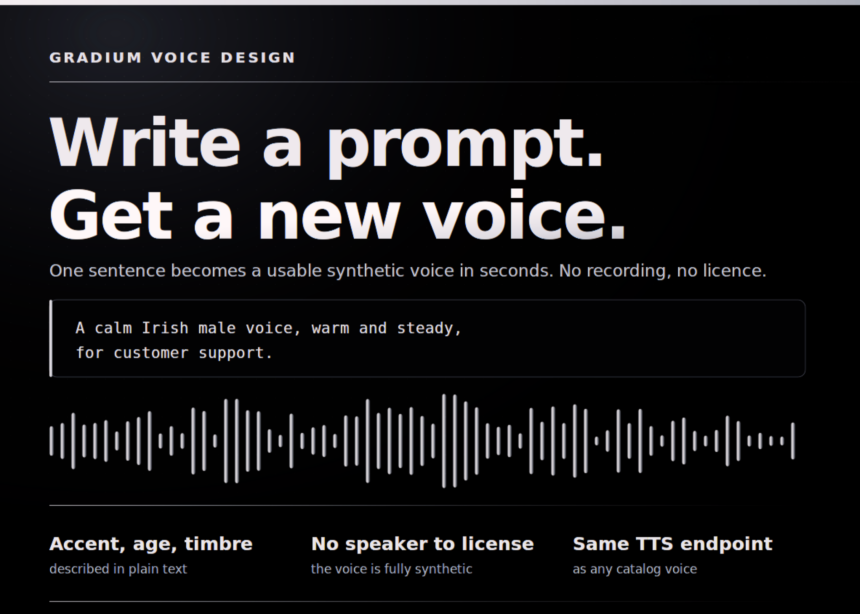
The challenge of scaling voice agents has long been defined by a rigid trade-off: use a generic, pre-trained catalog voice that fits few use cases, or commit to the resource-heavy, time-consuming process of cloning bespoke voices. Today, Gradium, a spin-out from the renowned Kyutai research laboratory, has introduced an architecture that bypasses this bottleneck. Their new Voice Design feature leverages a prompt-to-model approach, enabling the generation of entirely new synthetic voices from a textual description in seconds.
Rethinking Voice Synthesis Through Prompt Engineering
Instead of relying on reference audio or extensive datasets, Gradium’s system treats a textual prompt as a comprehensive casting brief. By describing the target persona—covering dimensions like age, gender, accent, tone, and the intended use case—developers can synthesize high-fidelity voices that don’t exist in a static library. Because no proprietary voice data is needed, the process eliminates the traditional legal and administrative overhead of rights management and consent.
Operational Workflow and Integration
Gradium has integrated this design capability directly into both its Studio interface and its primary API. The process of turning a prompt into a production-ready voice is structured around a four-step lifecycle:
- Generation: A
POST /voice-generator/generaterequest initiates the synthesis of candidate voices based on your description. - Polling: Since generation is an asynchronous process, developers poll
GET /voice-generator/embeddingsto track the status of the candidate voices. - Auditioning: Once ready, candidates can be tested via the standard Text-to-Speech (TTS) endpoint, using their unique candidate ID.
- Promotion: A
POST /voices/from-embeddingrequest finalizes the selection, promoting a candidate to a permanentvoice_idthat is immediately available for high-scale production use.
Key Operational Constraints
It is important to note the distinction between a temporary candidate and a finalized voice. Unconverted candidates are inherently ephemeral, remaining available only for 30 days before deletion. Additionally, candidates are limited to short-form testing—audition text is capped at 100 characters—and do not support real-time features like streaming WebSockets or Speech-to-Speech until they are converted into permanent, stored assets.
Performance and Comparative Benchmarks
To validate the efficacy of this approach, Gradium conducted a blind pairwise study against five major alternative voice systems. The evaluators, consisting of native speakers, compared unlabelled clips to determine which most accurately reflected the regional and stylistic nuances of the prompt. Gradium reported the following performance metrics:
| Model / Provider | Win Rate (Human Raters) |
|---|---|
| Gradium | 72.6% |
| ElevenLabs v3 | 59.0% |
| Inworld | 44.8% |
| Fish Audio | 36.7% |
| MiniMax | 31.7% |
The most significant divergence in quality appeared when the prompt required highly specific regional accents, which traditional catalog systems often struggle to differentiate. Gradium achieved particularly high success rates for accents such as Quebecois French (97%) and Rioplatense Spanish (86%).
Integration Summary
- Supported Languages: English, French, Spanish, Portuguese, and German.
- Prompt Length: Up to 500 characters, with better results obtained by being descriptive about timbre and register rather than using qualitative adjectives.
- Nondeterministic Nature: Because the system expands the prompt before sampling, every request for a new voice—even with the same seed—results in a unique acoustic profile.
- Resource Management: Converted voices share a storage quota with traditional cloned voices, varying by service tier (e.g., 5 slots on the free plan, 1,000 on enterprise tiers).