
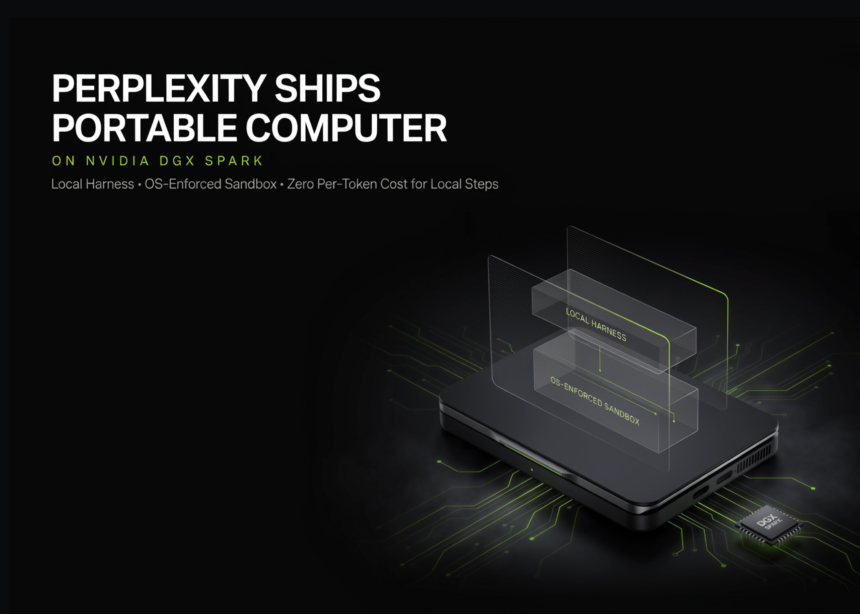
The landscape of agentic AI is shifting from purely cloud-dependent orchestrations toward local-first architectures. Perplexity has officially entered this space with its Portable Computer platform, a significant departure from standard cloud-reliant agent models. By integrating a complete agent harness, orchestrator, and sandbox directly onto hardware, Perplexity is addressing the critical bottlenecks of confidentiality, data residency, and token costs that have previously stalled enterprise adoption.
The Core Pillars of the Portable Computer Architecture
At its heart, the Portable Computer is designed to keep the entire execution stack within a local perimeter, specifically leveraging the NVIDIA DGX Spark. This is not merely a local inference wrapper; it is a full-stack deployment that bundles the agent harness, tool router, and the inference engine into a single unified system.
The architecture relies on three primary pillars:
- Local-First Orchestration: The agent logic resides on the device. Every task begins locally, meaning there is zero per-token cost for standard execution steps.
- The Escalation Gate: This is a sophisticated safety mechanism. When a request requires web access or complex reasoning that exceeds local capabilities, the orchestrator triggers an explicit human-in-the-loop approval step before routing to external frontier models.
- OS-Enforced Sandboxing: All tool execution and code generation are confined within a strict sandbox. This architecture manages filesystem access and process isolation, ensuring that local execution does not compromise the host system.
Benchmark Performance and Inference Efficiency
Perplexity has released proprietary data from its 53-task “Local Knowledge Work Bench.” The benchmarks indicate that the specialized PPLX 27B model, when paired with their internal harness, achieves significantly higher accuracy than generic open-source scaffolds running on the same hardware.
| Model/Scaffold Combination | Success Rate (53-Task Bench) | Performance Notes |
|---|---|---|
| PPLX 27B + Perplexity Harness | 85.4% | Optimized for local tool-use |
| Qwen 3.8 27B + Perplexity Harness | 82.6% | High efficiency in token usage |
| Qwen 3.8 27B + Pi Harness | 77.6% | Standard baseline |
| Qwen 3.8 27B + Hermes Harness | 74.0% | Generic scaffold baseline |
Cost Dynamics: The Hybrid Model
One of the most compelling aspects of the Portable Computer is the economic trade-off. While local execution incurs zero incremental cost, complex tasks that require escalation to external models follow a predictable pricing curve.
In tests utilizing Terminal Bench 2.1, the local-only approach achieved a 59.6% success rate with zero marginal cost. Escalating complex steps to an external “adviser” model improved the success rate to 73.0% at a marginal cost of approximately $0.415 per rollout. This represents a significant reduction in complexity and cost compared to relying entirely on frontier models like Claude Opus 5, which reach 82.4% accuracy but at a cost of roughly $0.65 per rollout.
Security and Egress Control
Perplexity has implemented a strict PII classifier that evaluates outgoing context before any data leaves the local machine. This is a critical security feature for enterprises operating in finance or legal sectors. When an escalation step is approved, the remote model receives only the approved context—not the entire local state, filesystem, or toolset. This “limited-exposure” approach ensures that even when the system leverages remote reasoning, the core intellectual property and local tools remain isolated within the sandboxed environment.
Platform Requirements
Because the platform ships as a hardware-bound system, it requires a significant initial investment. The reference design is built around the NVIDIA DGX Spark, featuring the GB10 superchip and 128 GB of unified memory. For broader deployment, it supports Linux environments with NVIDIA RTX GPUs possessing a minimum of 24 GB of VRAM. Support for Windows is scheduled for release in September, though there is currently no roadmap for macOS support.