
Understanding the New Standard in Speech-to-Text
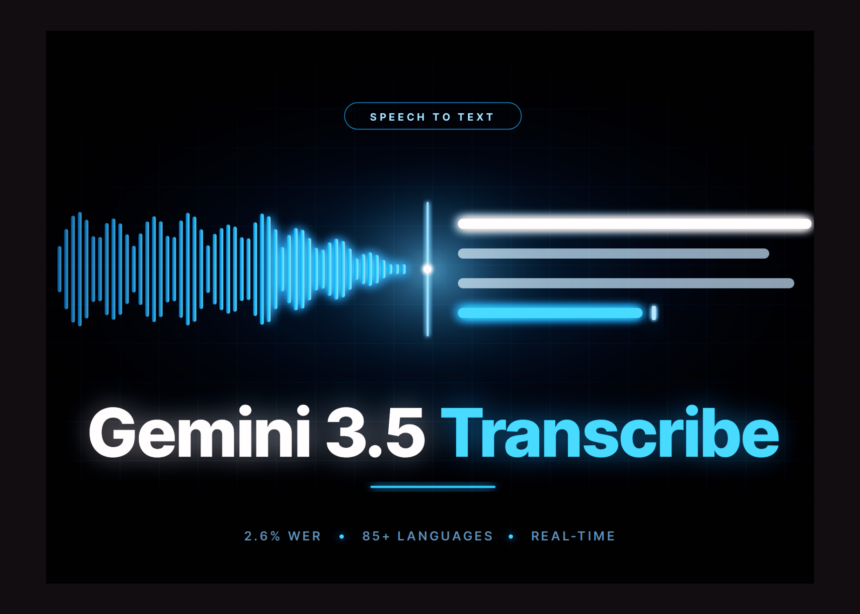
Google has unveiled Gemini 3.5 Transcribe, a sophisticated speech-to-text model architecture designed to bridge the gap between high-fidelity file processing and low-latency interactive voice systems. Rather than delivering a single catch-all model, the release differentiates between batch processing and real-time streaming, allowing developers to optimize for specific latency and feature requirements. This release represents a significant shift, prioritizing both speed and accuracy across a broad linguistic footprint.
Architectural Overview: The Two-Endpoint Split
The system is architected around two primary API endpoints, each serving distinct functional roles within an application stack. The technical choice between these two determines which features—such as diarization or word-level timing—are accessible.
- gemini-3.5-transcribe: This endpoint is built for the Interactions API, specifically optimized for pre-recorded audio files. It excels at complex, high-accuracy transcription tasks where real-time constraints are secondary to depth and structural metadata.
- gemini-3.5-transcribe-live: This is the engine for the Live API, facilitating bidirectional WebSocket streaming. It is engineered for low-latency, real-time voice interfaces, enabling fluid, human-like interaction loops.
Benchmarks and Performance Metrics
Google’s performance reporting, validated by third-party firm Artificial Analysis, highlights significant advancements over the previous generation, specifically the Chirp 3 architecture. The model shows a clear preference for accuracy in non-streaming modes while maintaining competitive thresholds in high-speed streaming scenarios.
| Metric | Streaming WER | Non-Streaming WER |
|---|---|---|
| Average (All Languages) | 4.0% | 2.6% |
| FLEURS Benchmark (Top Languages) | 5.50% | 5.04% |
Beyond error rates, the model achieves a 70% reduction in time-to-final-transcription compared to its predecessor. The architecture supports over 85 languages, automatically detecting them in real-time and managing mid-sentence code-switching without the need for manual configuration.
Verbatim vs. Smart Modes: Designing for Output
A critical architectural trade-off exists within the output processing settings. Developers must select between verbatim and smart modes, as these settings dictate the scope of available features.
- Verbatim Mode: The default setting preserves the raw input, including all stuttering, filler words, and false starts.
- Smart Mode: This mode performs inline cleaning, resolving self-corrections and formatting spoken content into structured text.
Crucially: Smart mode is mutually exclusive with diarization and word-level timestamp features. Architectural designs that require both high-level summaries and precise, auditable timing metadata must route audio through different processing paths.
Operational Limits and Deployment
Gemini 3.5 Transcribe is exclusively an API-managed service. There are no provisions for open-weights distribution or self-hosted containerization. For production deployments, the system categorizes usage into two tracks:
- Developer Track: Accessible via Google AI Studio, suitable for startups and individual developers. Free tiers exist, but moving to paid tiers removes usage data from Google’s product improvement cycle.
- Enterprise Track: Part of the Gemini Enterprise Agent Platform, providing compliance controls, volume-based pricing, and provisioned throughput for regulated industries.
Technical Constraints at a Glance
- Live API Sessions: Capped at 10 minutes of continuous streaming per session.
- File Processing: Standard files are accepted up to 60 minutes. Once speaker diarization or word-level timestamps are enabled, the limit compresses to 30 minutes.
- Speaker Attribution: Interactions API supports speaker diarization for up to 8 distinct voices, though attribution beyond two speakers is currently classified as experimental.
- Vocabulary Biasing: Custom vocabularies support up to 1,000 terms, with optimal performance observed under 100 entries.