
The Evolution of Dynamic AI Agent Training
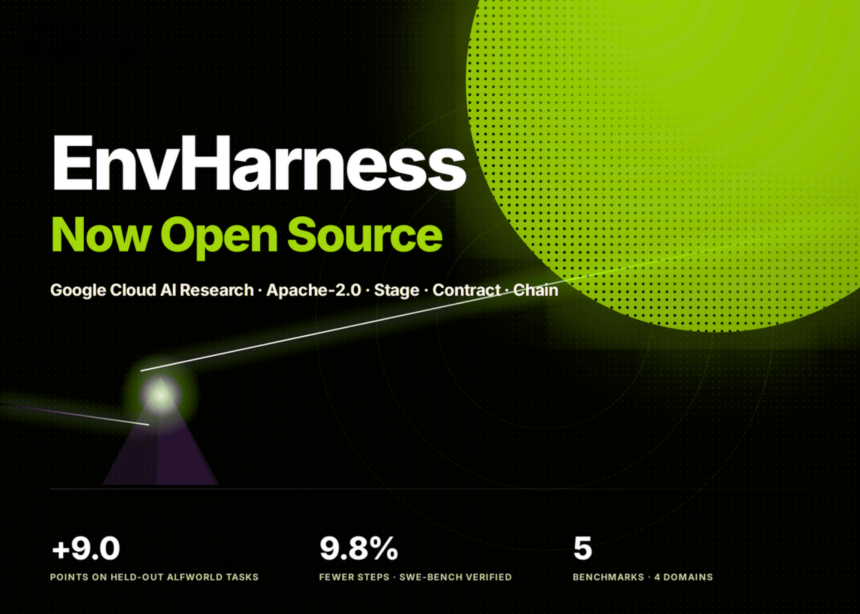
In the current era of Agentic AI, the bottleneck is no longer just the LLM’s reasoning capacity but the rigidity of the evaluation environments. Typically, researchers rely on static benchmarks where the environment behaves identically for every trial. This lack of adaptivity prevents agents from learning from their specific failures and creates a performance plateau once an agent masters the base tasks. Google’s newly introduced EnvHarness addresses this by shifting the paradigm from static simulation to a programmable, adaptive training interface.
Architecture: Wrapping the World
EnvHarness operates on a fundamental architectural shift: instead of attempting to modify a frozen environment’s backend code, it acts as a programmable wrapper. By utilizing the standard reset() and step() interface, it intercepts and transforms state, action, and observation data. Because the internal simulator remains completely untouched, developers retain the reliability of existing, human-built verifiers while gaining the ability to inject custom logic.
The framework is built upon three primary composition components:
- Stage: Modifies the initial state of an episode by replaying a sequence of actions after
reset(), forcing the agent to adapt to varied starting conditions, such as searching for an object in a closed container. - Contract: Enables per-step hooks to modify interactions, such as blocking invalid actions, truncating observations to force memory efficiency, or rewriting responses.
- Chain: Allows for the sequential composition of multiple environments within a single episode, enabling complex, multi-stage task training under a unified budget.
The EnvRigger Intelligence Loop
The system is powered by EnvRigger, an LLM-based designer that treats the agent’s policy as a black box. This designer follows a four-step lifecycle:
- Observation: Executes five baseline rollouts to capture the agent’s current capability.
- Diagnosis: Analyzes the rollouts to identify specific, systemic failure patterns.
- Design: Generates and installs targeted Python wrappers to address those flaws.
- Validation: Tests against five fresh rollouts to ensure the change is constructive, rejecting both trivial and impossible tasks.
Benchmark Results and Efficiency
EnvHarness consistently outperforms traditional methods across diverse domains, including ALFWorld and SWE-bench Verified. The following table summarizes the performance improvements observed in the study:
| Benchmark Domain | Baseline Success (%) | EnvHarness Success (%) | Net Improvement |
|---|---|---|---|
| ALFWorld | 62.4 | 68.3 | +5.9% |
| WebArena | 38.5 | 41.6 | +3.1% |
| SWE-bench Verified | 49.9 | 52.6 | +2.7% |
Beyond success rates, the framework demonstrates significant resource optimization. On SWE-bench Verified, the agent required 9.8% fewer execution steps to achieve its goals, validating that the adaptive training produces more efficient, less redundant policy rollouts.
Implementation Prerequisites
EnvHarness is an open-source, Apache-2.0 licensed Python framework. It is highly interoperable, requiring only that the target environment supports the standard reset/step pattern. However, the architecture imposes a strict requirement: the environment must be resettable. This limitation inherently excludes live production user accounts or non-simulated physical hardware.
Summary of Impact
- Non-Invasive: Operates entirely through existing interfaces without changing environment source code.
- Composable: Components can be mixed to create complex, adaptive curriculum training.
- Targeted Improvement: Automates the creation of training scenarios specifically designed to patch detected policy weaknesses.