
The New Standard for Local and Shared Agentic Infrastructure
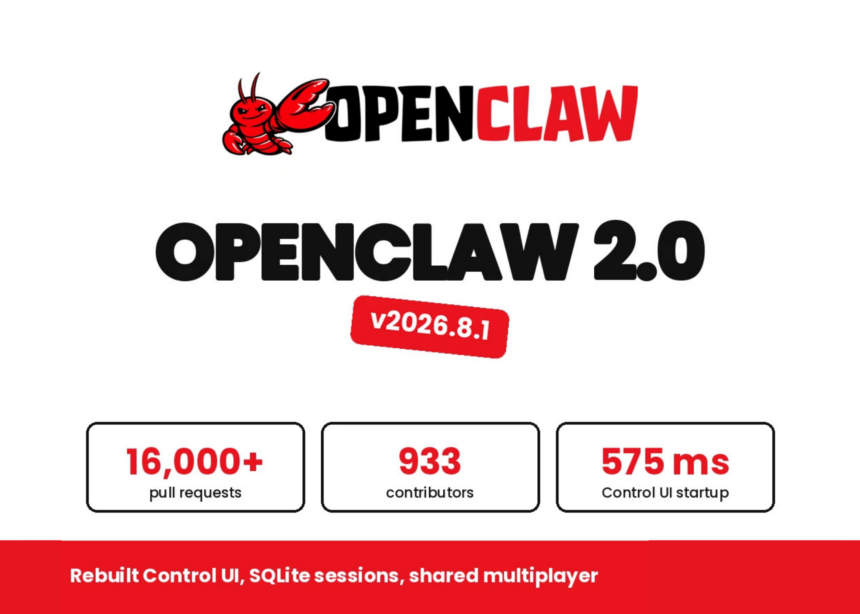
OpenClaw has finally broken its seven-week silence with the release of version 2.0. This update marks a significant shift in how developers handle agentic workflows, moving away from fragmented, file-heavy installations toward a unified, high-performance architecture. With over 16,000 pull requests merged from a community of nearly a thousand contributors, v2026.8.1 represents a massive stabilization effort focused on faster interaction loops and more cohesive session management.
Architecture and Performance Improvements
The most immediate change users will notice is the performance of the interface. The team completely re-engineered the Control UI, significantly reducing the overhead that historically hampered browser-based interaction. By replacing the older, file-reliant session management with a SQLite backend, the application achieves a much tighter coupling between user intent and agent execution. In a benchmark environment—simulating a standard chat interaction with a gateway experiencing 50 ms HTTP/1.1 latency—the engineering team recorded the following improvements:
| Metric | Legacy Version | OpenClaw 2.0 |
|---|---|---|
| JavaScript Requests | 140 | 45 |
| Control UI Startup | 1.6 seconds | 575 ms |
Simplified Onboarding and Credential Management
The new guided setup process is designed to minimize configuration friction. Instead of manual setup, the installer automatically detects existing authentication credentials on your machine. It can seamlessly import verified CLI sessions for ChatGPT, Codex, and Claude. For those building locally, the system now manages a native llama-server, replacing the older node-llama-cpp implementation. This change enables a default 64K context window, with Gemma 4 serving as the out-of-the-box default for RAM-gated hardware.
Multiplayer Sessions and Security Boundaries
A major addition to 2.0 is the introduction of shared cloud sessions. This feature allows multiple users to join a live workspace to assist with complex tasks. However, it is critical to understand the platform’s security posture regarding these sessions:
- Shared Sessions: These are designed for collaboration, not as a security isolation layer. They do not constitute a multi-tenant boundary.
- Trust Boundaries: The system enforces one trust boundary per gateway. The gateway defaults to binding only to the loopback interface, restricting external access.
- Mitigation Strategy: OpenClaw emphasizes model choice as the first line of defense against prompt injection.
The team provided performance data based on 272,000 attacks across 41 distinct agent scenarios, measuring the success rate of malicious actors in triggering unauthorized actions:
| Model | Success Rate of Attack |
|---|---|
| Claude Opus 4.5 | 0.5% |
| Claude Sonnet 4.5 | 1.0% |
| Claude Haiku 4.5 | 1.3% |
| Gemini 2.5 Pro | 8.5% |
Deployment Guidance
While OpenClaw 2.0 is robust for individual operators or cohesive teams, it is not currently positioned for multi-tenant SaaS products. Because the architecture relies on shared gateway contexts, administrators should maintain one isolated gateway instance per tenant. For users migrating from previous versions, the move to SQLite requires care; you must ensure the current CLI restores legacy transcripts before upgrading, and keep in mind that backward compatibility is limited.