
The New Standard for Real-Time Conversational AI
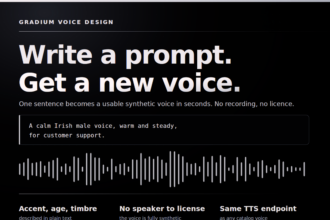
Modern voice agents often falter where accuracy matters most—the transactional details. Whether it is confirming an alphanumeric order number, transcribing a callback phone sequence, or dictating an email address, these critical data points are the primary failure modes in conversational AI. To address this, Gradium AI has overhauled its text-to-speech (TTS) stack, moving a new model into the default position across its full API and studio environment.
This release is not just an incremental tuning update; it represents a fundamental improvement in handling the high-entropy strings that traditionally plague synthetic voices. The result is a system capable of navigating complex, sensitive caller data with a significantly higher fidelity than previous iterations.
Accuracy and Latency: Measuring the Gap
Gradium evaluated this model using a 500-sentence hard-case dataset, specifically designed to test the model on the most difficult linguistic edge cases. The evaluation spanned five languages: English, French, German, Spanish, and Portuguese. When subjected to rigorous human-rating, the new model demonstrated a clear performance lead over existing state-of-the-art solutions.
The benchmarking results are summarized below, reflecting the pass rates achieved by each vendor on the proprietary hard-case evaluation set:
| Model / Vendor | Hard-Case Pass Rate |
|---|---|
| Gradium AI (New Default) | 81.0% |
| Cartesia Sonic 3.6 | 75.1% |
| ElevenLabs v3 Conversational | 65.4% |
| Fish Audio S2.1 Pro | 49.5% |
| Inworld TTS 1.5 Max | 46.5% |
Beyond raw accuracy, latency remains the defining metric for voice agents. Gradium reports a 216 ms time-to-first-audio at the P50 level when measured via the Coval benchmark. This represents a 170 ms reduction compared to the previous generation, placing Gradium in a competitive bracket for sub-250 ms real-time performance.
Why the Consistency Matters
While median latency is the standard industry metric, users rarely care about the median; they care about the tail-end performance. In a live telephone interaction, a spike in latency manifests as an awkward silence that ruins the illusion of a human-like flow. Gradium’s performance data highlights a tight 30 ms interquartile spread (P75-P25) across 480 runs, indicating highly predictable output timing.
In contrast, other models—such as Cartesia Sonic 3.6, which posts a 454 ms median—exhibit much higher variance, with a 165 ms spread that can result in unpredictable delays during critical phases of a conversation.
Deployment and Integration
For engineering teams currently relying on Gradium’s infrastructure, the transition is seamless. The new model was promoted to the default status on August 31, 2026, meaning no migration or code changes are required to leverage the improved accuracy. Existing voice configurations and custom clones remain fully compatible with the updated architecture.
- Zero-Migration Path: Fully backwards compatible with current API implementations.
- Development Stacks: Direct support for Pipecat and LiveKit, alongside a robust Python SDK and standard WebSocket endpoints.
- Open Evaluation: Gradium has provided the 500-sentence evaluation dataset on Hugging Face (CC BY 4.0), allowing developers to independently verify the pass rates.
This update positions Gradium as a top-tier choice for developers building e-commerce support, telecom helpdesks, and logistics agents—use cases where a single mispronounced character in a reference code is equivalent to a failed interaction.