
A New Paradigm in Unified Audio Processing
For years, engineering teams have been forced to cobble together complex voice pipelines—daisy-chaining separate models for transcription, speaker isolation, and activity detection. This fragmented approach not only introduces cascading latency issues but also creates multiple points of failure. Meta Superintelligence Labs has now fundamentally challenged this architecture with the release of Muse Voice Transcribe, an innovative audio perception model that integrates these functions into a singular, autoregressive stream.
Architecture: From Three Models to One
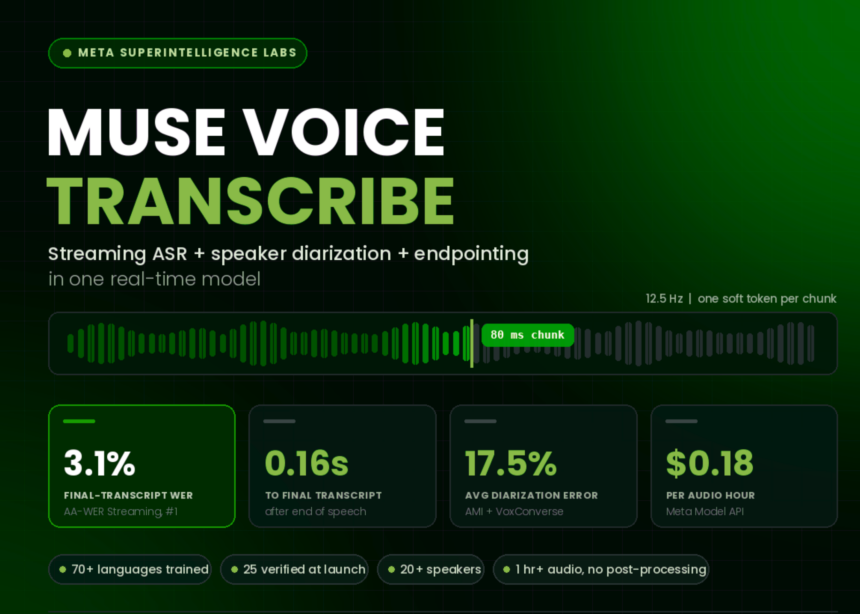
At its heart, Muse Voice Transcribe moves away from post-processing workflows by handling streaming Automatic Speech Recognition (ASR), speaker diarization, and endpointing within a unified autoregressive framework. The model processes audio in 80ms windows, converting incoming signal chunks into discrete soft tokens.
The model’s intelligence lies in its decision-making loop. After analyzing each audio chunk, it executes a binary choice: it either generates a <|next_audio|> token to request more audio input or emits a text token to update the transcript. This loop ensures that the model maintains its own context window without requiring an external alignment stage. When the session concludes, an <|empty_audio|> token instructs the system to finalize and flush all pending text. By collapsing these tasks into one loop, Meta has effectively eliminated the alignment drift common in multi-stage voice systems.
RL-Driven Adaptive Delay
One of the most sophisticated aspects of Muse Voice Transcribe is its approach to the inherent trade-off between latency and accuracy. In traditional systems, delay is a fixed parameter. Meta, however, treats delay as a dynamic variable trained via reinforcement learning.
By applying multiplicative rewards based on Word Error Rate (WER) and delay time, the training process creates an “adaptive delay” policy. The model learns to adjust its buffer dynamically; it intentionally holds back tokens for complex segments to increase accuracy while reacting rapidly during simpler passages. This optimization places the model on the performance Pareto front, allowing it to outperform established benchmarks while maintaining competitive speed.
Diarization and Endpointing
Rather than relying on side-car models for speaker tracking or voice activity, Meta uses specialized control tokens inserted directly into the primary stream.
- Diarization: The model uses
<|start_of_turn|>tokens to anticipate speaker transitions and<|speaker_{A-Z}|>tags to identify contributors. This allows the model to handle 20+ speakers simultaneously within the same continuous stream. - Endpointing: Instead of monitoring power levels, the model uses
<|speech_onset|>and<|speech_endpoint|>tokens to define the boundaries of human speech, ensuring the agent stops listening exactly when the user is finished.
Performance Benchmarks
Meta claims top-tier status on the Artificial Analysis leaderboard as of September 1, 2026. The data highlights a significant breakthrough in balancing precision with real-time responsiveness.
| Model | Final WER | Latency (Post-speech) | Price / 1,000 min |
|---|---|---|---|
| Muse Voice Transcribe | 3.1% | 0.16 s | $3.00 |
| Cartesia Ink-2 (semantic) | 3.4% | 0.43 s | $4.00 |
| ElevenLabs Scribe v2 Realtime | 3.6% | 0.14 s | $6.50 |
| Cartesia Ink-2 (external) | 4.0% | 0.07 s | $4.00 |
Regarding diarization, the model achieved a 17.5% average error rate across standard benchmarks (AMI-IHM, AMI-SDM, and VoxConverse), significantly outperforming competitive systems that ranged between 21.1% and 28.6%.
Deployment and Accessibility
While Meta has released the model to power their own internal products like Meta AI for Mac and Muse Code, it is exclusively available as a managed service. There is no open-weight release for self-hosting. Developers can access the model through the Meta Model API (identified as muse-voice-transcribe-1.0) at a rate of $0.18 per hour.
The model supports over 70 languages, with 25 currently verified for production use. A key feature for global applications is native code-switching support, allowing the model to handle seamless transitions between languages within the same sentence or clause.