
Balancing Data Privacy with Security Oversight
In the evolving landscape of enterprise AI, organizations often encounter a friction point: the mandate for zero data retention (ZDR) versus the necessity of robust security and misuse detection. Traditionally, ensuring an AI vendor does not retain any user inputs or agent transcripts forced a binary choice. Security teams lost the ability to monitor for malicious patterns, while privacy-focused teams kept their data silos but blind-spotted the risks of credential theft or platform exploitation.
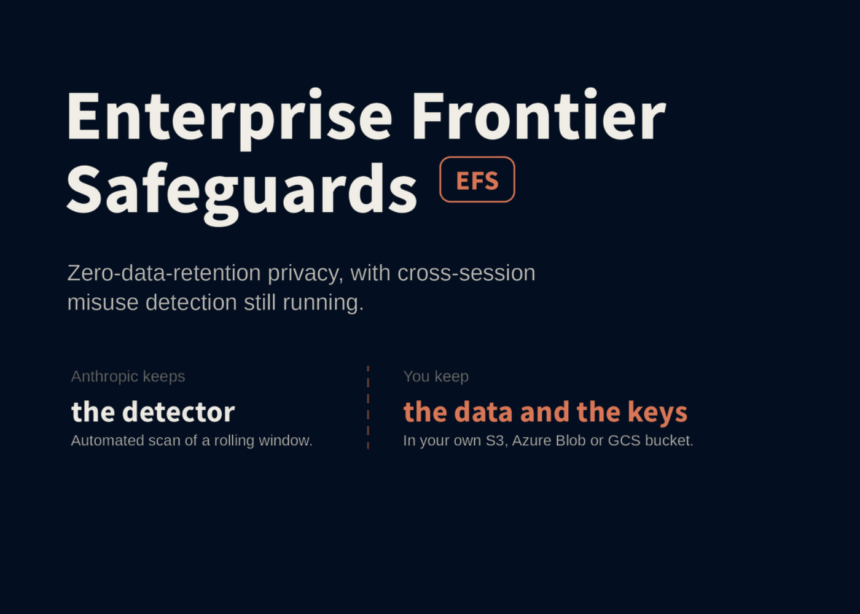
Anthropic’s latest solution, Enterprise Frontier Safeguards (EFS), attempts to bridge this divide. By decoupling data custody from monitoring infrastructure, the platform allows for advanced behavioral detection without Anthropic holding the raw data. This approach shifts the custodial responsibility—and the associated audit logs—to the customer’s preferred cloud environment, effectively satisfying internal compliance mandates while maintaining platform-wide security oversight.
The Technical Architecture of EFS
The EFS architecture relies on a fundamental shift in how activity data is handled. Instead of routing all telemetry to an Anthropic-managed database, the new architecture integrates with standard enterprise cloud storage.
- Custody via Customer Cloud: Raw activity logs used for monitoring are stored directly in buckets owned by the enterprise (supporting Amazon S3, Azure Blob, or Google Cloud Storage). This ensures the data remains under the customer’s encryption keys, access policies, and compliance monitoring.
- Automated Detection: Anthropic’s detection systems process a rolling window of traffic. The logic is optimized to identify multi-session attacks—such as sophisticated attempts to build offensive cyber capabilities or biological threats—that would be invisible to per-request filtering.
- Human-in-the-Loop Control: When a flag is raised, the signal is routed to the customer’s internal security teams. Enterprises can leverage their own cleared staff to perform human review, clearing false positives or addressing genuine incidents without any Anthropic employees accessing the sensitive data.
Infrastructure and Compliance
The development of EFS involved close collaboration with over 100 enterprise customers, spanning heavily regulated sectors like financial services, healthcare, and retail. Through the Analysis and Resilience Center for Systemic Risk, Anthropic aligned this architecture with the specific security requirements of global systemically important banks and Fortune 100 organizations.
The following table illustrates the shift in responsibility introduced by this model:
| Feature | Standard Retention | Enterprise Frontier Safeguards |
|---|---|---|
| Data Custody | Anthropic | Customer (Cloud Bucket) |
| Encryption Keys | Anthropic Managed | Customer Managed |
| Human Review | Anthropic Personnel | Customer Internal Security |
| Detection Logic | Anthropic | Anthropic |
Model Performance and Operational Impact
Beyond the EFS announcement, the company has updated its model lineup to address cost and performance. Fable 5.1 and Mythos 5.1 are now central to this deployment strategy. Key performance and cost metrics for these models include:
- Cost Efficiency: Cache read costs have been reduced by 75% to $0.25 per million tokens. Depending on the workload, enterprises can expect a 25% reduction in standard costs, rising to 45% for agent-heavy tasks.
- Safety Interventions: Updates to cybersecurity safeguards in Fable 5.1 have resulted in roughly 60% fewer unwanted interventions per session compared to the previous Fable 5 version. The model is specifically tuned to recognize software vulnerabilities without being prompted to generate exploitative code.
Next Steps for Enterprise Adoption
EFS is currently being rolled out in phases, with broad availability scheduled for late autumn. Organizations interested in the architecture must currently apply through a request-based process. Until full implementation, eligible enterprises can continue to run Fable 5 and 5.1 configurations under existing zero-data-retention (ZDR) agreements.
By effectively removing the barrier of data custody, EFS provides a path for regulated organizations to adopt frontier-level AI models without compromising on internal security, auditing, or privacy standards.