
The Evolution of Gemini: Beyond Simple Model Updates
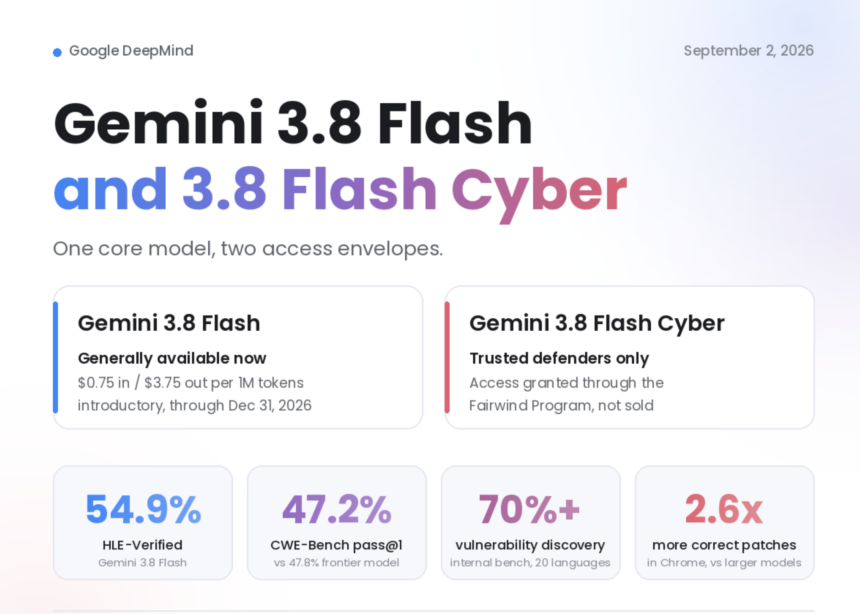
Google DeepMind has introduced a strategic pivot in its large language model distribution with the release of Gemini 3.8 Flash and its restricted counterpart, Gemini 3.8 Flash Cyber. This launch, occurring just weeks after the deployment of the 3.7 series, emphasizes a shift toward model refinement through recursive evaluation and agentic feedback loops rather than solely relying on architectural overhauls.
Shared Foundational Intelligence, Divergent Access
At their core, both 3.8 Flash and 3.8 Flash Cyber share an identical foundational engine. They maintain the industry-standard capabilities introduced in previous iterations, including a massive 1,048,576-token context window and a 65,536-token maximum output limit. The models process multi-modal inputs spanning text, imagery, audio, and video, ensuring high versatility for developers.
The distinction lies in the distribution model and safety framework. Gemini 3.8 Flash is available for immediate production deployment via the Gemini API, Google AI Studio, and Google Cloud Enterprise platforms. Conversely, Flash Cyber is strictly gated. Access is mediated through the Fairwind Program, focusing on critical infrastructure providers and authorized security researchers, ensuring that the model’s specialized defensive capabilities are managed under stringent oversight.
Performance Profiles and Operational Trade-offs
The move to 3.8 introduces a deliberate shift in how the model handles complex reasoning. Google has explicitly stated that 3.8 Flash is designed to expend more computational effort on challenging prompts. It utilizes iterative tool calling and deeper reasoning chains by default. Consequently, developers may observe higher token consumption compared to the 3.7 series, making the 3.7 model a potentially more cost-effective choice for tasks where compute budget is the primary constraint.
A notable breaking change for existing API users is the removal of the MINIMAL thinking level. Setting this parameter on 3.8 Flash will now result in an API validation error, forcing developers to select from the LOW, MEDIUM, or HIGH tiers.
Key Performance Metrics
Google has highlighted significant gains across specialized benchmarks, emphasizing the model’s ability to act as a highly efficient autonomous agent.
| Benchmark/Metric | Model | Performance Result |
|---|---|---|
| HLE-Verified (Long-horizon Software Engineering) | 3.8 Flash | 54.9% |
| CWE-Bench (Patching) | Flash Cyber | 47.2% pass@1 |
| Vulnerability Discovery (Internal 20-lang suite) | Flash Cyber | > 70% success rate |
| Chrome Security Patch Accuracy | Flash Cyber | 2.6x improvement vs. larger models |
Security and Defensive Capabilities
Flash Cyber has been specifically tuned for vulnerability discovery and automated patching. While Google has optimized it for defenders, the model demonstrates high recall on industry-standard penetration testing benchmarks. Internal testing with partners like Wiz indicates a recall improvement of 7.5 to 9.7 percentage points compared to larger frontier models, while achieving significant reductions in operational costs. Because of the model’s potency in identifying and addressing vulnerabilities, Google has opted for a controlled release, prioritizing security above the open availability of offensive exploitation capabilities.
Summary of Technical Changes
- Reasoning Dynamics: 3.8 Flash prioritizes accuracy through more aggressive reasoning and iterative tool usage.
- API Update: The MINIMAL configuration level has been deprecated.
- Access Control: Flash Cyber is restricted to trusted defenders via the Fairwind Program to prevent potential misuse.
- Cost Efficiency: While 3.8 Flash may consume more tokens per task, it achieves frontier-level performance in complex agentic tasks at a lower price point than massive, general-purpose models.