
The Search Bottleneck in Agentic Workflows
Coding agents often face a significant hurdle: balancing the need for precise symbol retrieval with the requirement for conceptual understanding. Traditional tools like ripgrep are excellent for finding exact string matches but fail when an agent needs to explore behaviors described in vague or natural language. This leads to inefficient patterns, such as agents guessing keywords, reading unnecessary files, or manually stitching together context, all of which inflate token consumption and increase latency.
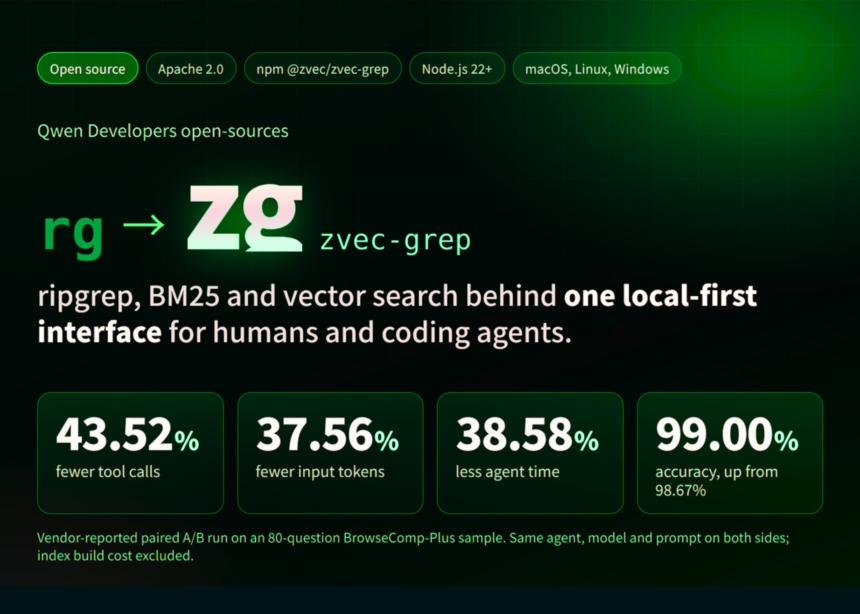
The Qwen team has introduced zg (zvec-grep), a novel, open-source local-first search layer designed to bridge this gap. By unifying ripgrep, BM25 (Best Matching 25), and vector-based semantic search into a singular, high-performance interface, zg offers developers and autonomous agents a more rational way to interact with large codebases.
Unified Search Architecture
Unlike standard search utilities that treat lexical and semantic queries as separate silos, zg implements an indexed approach that treats them as collaborative components. Once a workspace is indexed, zg provides four primary retrieval paths, allowing users to fine-tune search behavior based on the specificity of the query:
- Hybrid (Default): Combines lexical anchors with semantic intent, providing the best of both worlds for natural language queries.
- BM25 (
--fts): Ranks results based on the relevance of exact terms, ideal for keyword-heavy lookups. - Vector (
--vector): Utilizes conceptual similarity, stripping away lexical constraints for broad behavioral searches. - Ripgrep (
--rg): Performs literal string or regex matching, bypassing the index entirely for situations where precision is absolute and the repository state may not be indexed.
The indexing process occurs within a local .zvec-grep/ directory. Importantly, zg handles lifecycle management gracefully, ignoring .git, dependency folders, and common build artifacts by default. It also provides a fresh or possibly_stale status, giving agents the situational awareness to decide if they need to update the index before executing a mission-critical tool call.
Integration and Deployment
Deployment is straightforward, as zg is designed to work with existing environments. It is available as a Node.js package (@zvec/zvec-grep) and supports macOS, Linux, and Windows. Crucially, the tool adheres to the Model Context Protocol (MCP) and can automatically wire itself into platforms like Cursor, Claude Code, and OpenCode.
In terms of security and resource management, the system remains strictly on-device by default. Embeddings are generated using local models—such as the default local/potion-code-16m-v2—meaning no data leaves the machine. Even when using remote Qwen endpoints, zg requires explicit, user-revoked authorization via zg auth grant, preventing silent data egress.
Performance and Benchmarks
According to initial findings from the developers, the impact of implementing this unified search layer is substantial in terms of resource optimization. Testing on a subset of SWE-QA-Bench and BrowseComp-Plus revealed significant reductions in token usage and agent latency.
| Metric | SWE-QA-Bench Reduction | BrowseComp-Plus Reduction |
|---|---|---|
| Input Tokens | ~50% | 37.56% |
| Tool Calls | >50% | 43.52% |
| Agent Latency | N/A | 38.58% |
While the accuracy on the BrowseComp-Plus benchmark improved from 98.67% to 99.00%, the core value remains in the dramatic efficiency gains. Indexing large projects is also performant; for example, indexing the entire Django repository (3,457 files) takes under 30 seconds on an Apple M4 Pro.
Final Perspectives
For developers building agentic workflows, the key takeaway is the architectural restraint implemented by the team. The zg server exposes only two primary tools (zvec_grep_search and zvec_grep_rg), keeping the complex index management logic firmly within the user’s CLI control. By ensuring agents cannot silently alter the indexing state, zg maintains a predictable and robust development environment.
- Unified Interface: Consolidates ripgrep, BM25, and vector search under one roof.
- Local-First Privacy: Keeps embedding and indexing on-device; remote usage is strictly opt-in.
- Efficiency: Demonstrated capability to halve token usage and tool call frequency.
- Compatibility: Apache 2.0 license, npm-installable, and supports Windows, Linux, and macOS.