
The Shift Toward Long-Horizon Agentic Work
The latest iteration of Meta’s coding model, Muse Spark 1.3, marks a significant departure from standard instruction-tuned language models. Instead of focusing on single-turn code generation, this release optimizes for long-horizon agentic workflows. As software architects, we have seen that the primary friction in agentic systems is not just the model’s reasoning capabilities, but its ability to manage multi-step, stateful collaboration without falling into repetitive loops or exhausting the context window.
Muse Spark 1.3 emphasizes sustained engagement. It is engineered to maintain a cohesive thread over extended development cycles, gathering context from disparate, often conflicting information sources, and dynamically patching its own internal plan. This capability is critical for complex coding tasks where the agent must integrate multiple subsystems, diagnose failures, and maintain environmental state over thousands of tokens.
Efficiency Gains and Performance Metrics
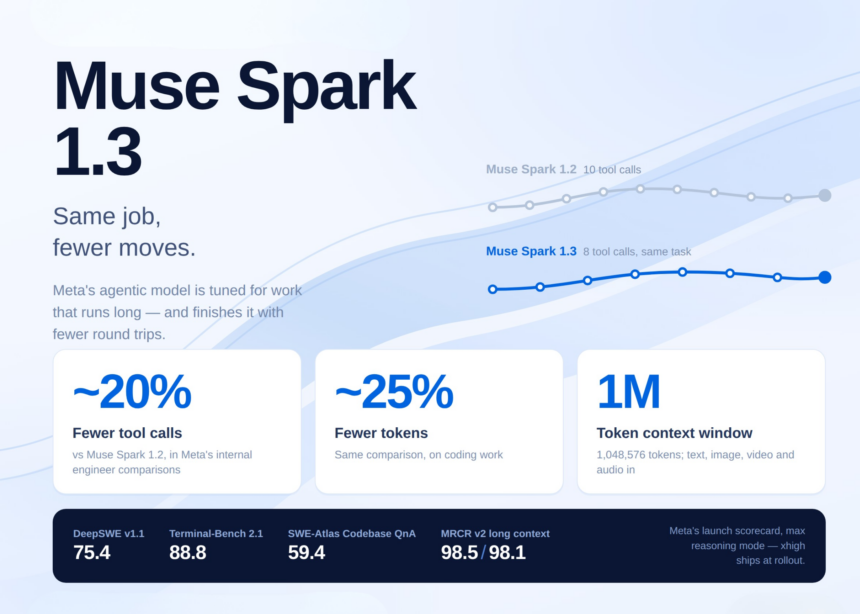
Meta’s engineering team has focused on reducing the overhead typical of agentic loops. By refining the model’s internal reasoning logic for long-horizon tasks, they have achieved notable improvements in resource utilization compared to the previous Muse Spark 1.2 release. These metrics directly correlate to faster execution times and reduced operational costs per task.
| Metric | Relative Improvement (vs. 1.2) |
|---|---|
| Tool Call Frequency | ~20% Reduction |
| Token Usage per Task | ~25% Reduction |
By minimizing unnecessary tool invocations and streamlining the generated tokens, Muse Spark 1.3 effectively reduces the round-trip latency inherent in agentic workflows. For developers, this means the model spends less time navigating through verbose cycles and more time focusing on objective completion.
Collaborative Agentic Intelligence
A primary architectural feature of this release is its calibrated autonomy. In production agentic environments, a model that operates in total silence is often a liability. Muse Spark 1.3 includes refined behaviors for engagement:
- Adaptive Clarification: When a task objective is ambiguous, the model is trained to solicit user clarification before consuming resources.
- Stall Recovery: When the agent detects an internal dead-end, it signals the user with specific information regarding the blockage.
- Action Calibration: The model is now better at identifying when an action is irreversible, requiring explicit user confirmation before execution.
- Preference Alignment: Users can tune the model to operate either in a silent background mode or a verbose, status-heavy communication style.
Deployment and Availability
Muse Spark 1.3 is currently available via the Meta Model API and within the Muse Code development environment. However, there are architectural limitations to consider for those looking to integrate this model:
- Closed Weights: The model currently requires API-based consumption; self-hosting is not supported at this time.
- Reasoning Tiers: While the base model is available for general use, the advanced ‘max’ reasoning configuration remains gated for safety testing.
- Context Window: The model supports a robust 1M-token context window, allowing for extensive codebase analysis and deep-thread state management.
For organizations building agentic systems, Muse Spark 1.3 represents a significant evolution in how models manage the tradeoff between agentic autonomy and user-in-the-loop control. By curbing verbosity and improving efficiency in tool usage, it provides a more predictable and cost-effective foundation for long-running software engineering tasks.