
The Engine Room: How Perplexity Powers Vector Search
In the high-stakes world of AI-powered search, the quality of retrieval is limited by two critical factors: the sophistication of the embedding model and the sheer efficiency of running it at massive scale. Recently, Perplexity shared an inside look at the infrastructure behind pplx-embed, the system driving their search, computer, and API platform. Rather than building a dedicated embedding server from the ground up, the team opted to extend their existing LLM serving stack, proving that embedding models benefit significantly from the performance optimizations typically reserved for large-scale generative models.
The Three Pillars: Ivy, Tulip, and ROSE
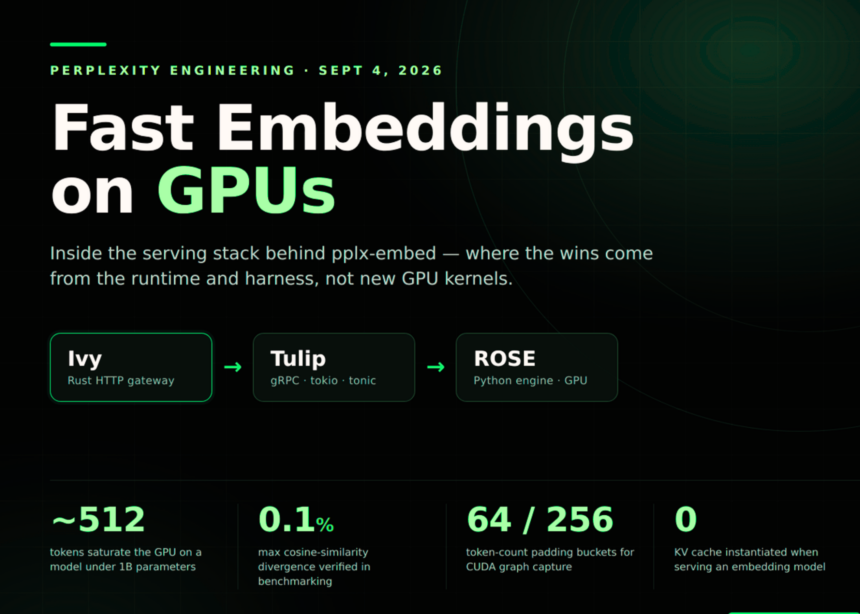
The serving architecture is divided into three distinct functional layers, each handling specific stages of the request lifecycle:
- Ivy (The Gateway): Built on Rust, this HTTP gateway manages the heavy lifting of request preparation. It handles JSON parsing, tokenization, input templating, and batch splitting. By chunking large requests, Ivy effectively balances the load across system replicas, mitigating the latency spikes often caused by variable production payloads.
- Tulip (The Interface): Acting as the orchestration layer, Tulip is a gRPC server designed with Rust,
tokio, andtonic. It prioritizes simplicity, implementing a first-come, first-served queue that aggregates requests into optimal batches before passing them to the engine. - ROSE (The Engine): The Runtime-Optimized Serving Engine (ROSE) is the core of the stack. Primarily Python-based, it provides the necessary model layers, manages kernel execution, and handles the intricate details of CUDA graph scheduling.
Optimizing the GPU Execution Path
The engineering team discovered that for their target embedding models—which are relatively small Transformers—the linear cost of dense layers often eclipses the quadratic cost of attention. This finding influenced their scheduling strategy: because latency is more closely tied to token volume than the number of sequences, they found that once a GPU batch hits 512 tokens on a sub-billion-parameter model, the performance gains of packing additional sequences reach a point of diminishing returns.
To keep the hardware saturated without wasted overhead, they implemented two specific performance strategies:
- CUDA Graph Capture: To prevent CPU-side kernel launch overheads from bottlenecking the GPU, Perplexity utilizes whole-model CUDA graphs. These capture every launch into a singular driver call. To solve the issue of dynamic inputs, they perform a lazy capture: the system runs an eager warmup phase, followed by automated capture and replay on subsequent iterations.
- LazyTensor Overlap: Traditional blocking calls are a performance killer. ROSE uses
LazyTensor, which bundles a host buffer, an asynchronous device-to-host copy, and a CUDA event. This abstraction allows the system to prepare and tokenize batch N+1 while the device is still computing batch N, significantly improving overall pipeline throughput.
Kernel Strategy and Performance
While the team experimented with multiple attention backends, they noted that backend selection remains highly specific to the model and sequence length. While FlashAttention 4 is the baseline for performance, FlashInfer 3 often demonstrates superior results for Qwen-based architectures at extreme sequence lengths. By avoiding the allocation of a key-value (KV) cache and favoring ragged attention variants, the ROSE engine is able to process these inputs without the memory overhead associated with standard LLM serving.