
Revolutionizing Computer-Use Agent Infrastructure
The current landscape for developing and evaluating autonomous computer-use agents (CUAs) has been hampered by significant infrastructure friction. While model capabilities for controlling desktops, browsers, and mobile environments are advancing rapidly, the supporting ecosystems have remained dangerously fragmented. Researchers frequently grapple with disparate, incompatible interfaces when attempting to bridge agents, sandboxed environments, evaluation traces, and training pipelines.
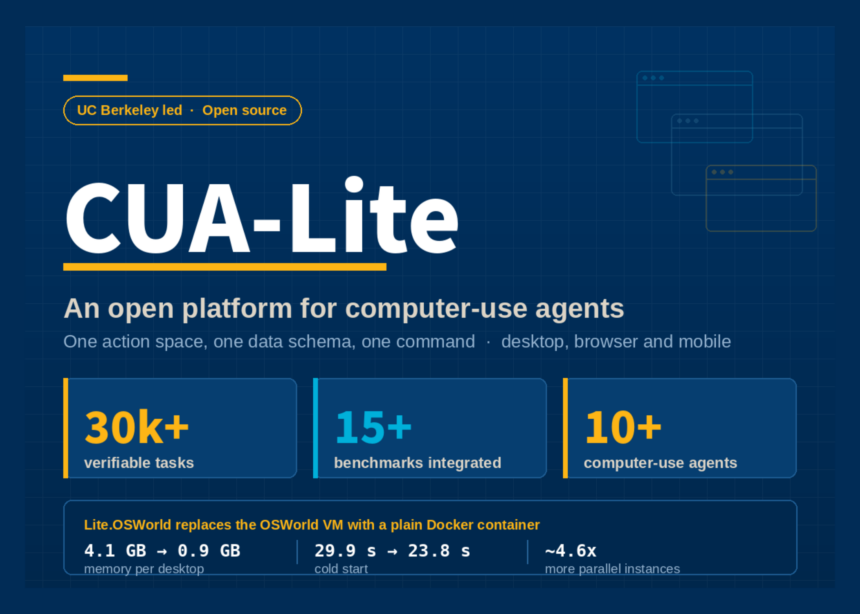
The release of CUA-Lite by researchers at UC Berkeley addresses these bottlenecks head-on. By unifying these disjointed layers into a single, cohesive framework, the platform streamlines the entire lifecycle of agent development. It introduces a standardized action space and a robust, shared data schema, enabling developers to shift their focus from managing complex environmental scaffolding to iterating on agent intelligence.
The Shift to VM-Free Sandboxing
Perhaps the most significant architectural advancement in CUA-Lite is the introduction of Lite.OSWorld. Traditionally, benchmarking agents required running full virtual machines—typically using QEMU/KVM—to maintain environmental fidelity. This created a heavy operational tax, necessitating nested virtualization that is rarely available in standard cloud-based infrastructure. Lite.OSWorld removes this dependency by delivering a feature-equivalent GNOME desktop experience within a lightweight Docker container.
The performance benefits of this transition are substantial:
| Metric | Traditional OSWorld (VM) | Lite.OSWorld (Container) |
|---|---|---|
| Runtime Engine | QEMU/KVM Virtual Machine | Docker Container |
| Host Infrastructure | Requires /dev/kvm & Nested Virt |
Any Standard Docker Host |
| Memory Footprint | 4.1 GB | 0.9 GB |
| Cold Start Time | 29.9 seconds | 23.8 seconds |
| Instance Density | Baseline | ~4.6x improvement |
Despite the lighter footprint, the team reports that performance remains highly consistent. Across a evaluation suite of 13 models, the scores achieved within the Docker-based container accurately mirror those of the VM-based OSWorld, ensuring that training signals and benchmarks retain their reliability while drastically reducing resource consumption.
Standardizing the Data Lifecycle
Beyond sandboxing, CUA-Lite addresses data inconsistency through LiteSample. This supervised learning schema acts as a universal language for agents, abstracting away the platform-specific quirks of various environments. By shipping as standardized parquet files coupled with visual assets, it makes a massive array of existing datasets—such as Aguvis, OpenCUA, ScaleCUA, and Mind2Web—interoperable with minimal configuration.
The platform also includes intelligent per-model adapters. These components automatically translate the unified LiteSample format into the specific input requirements of various model families, handling complex tasks like history collapsing, which allows multiple steps to be consolidated into a single forward pass during training.
One-Command Execution
CUA-Lite centralizes the entire development workflow into a single command-line interface. Developers can now execute evaluation, Supervised Fine-Tuning (SFT), and Reinforcement Learning (RL) tasks using a consistent set of arguments. The framework supports a massive variety of agents, from proprietary frontier models to open-source powerhouses like UI-TARS and Fara-7B.
The platform enables complex operations like distilling knowledge from teacher models into smaller student models through automated rollout generation. With support for over 40 diverse applications—including complex software like Blender and VS Code—and a combined suite of over 30,000 verifiable tasks, CUA-Lite provides the necessary depth for serious research and production-grade agent alignment.