
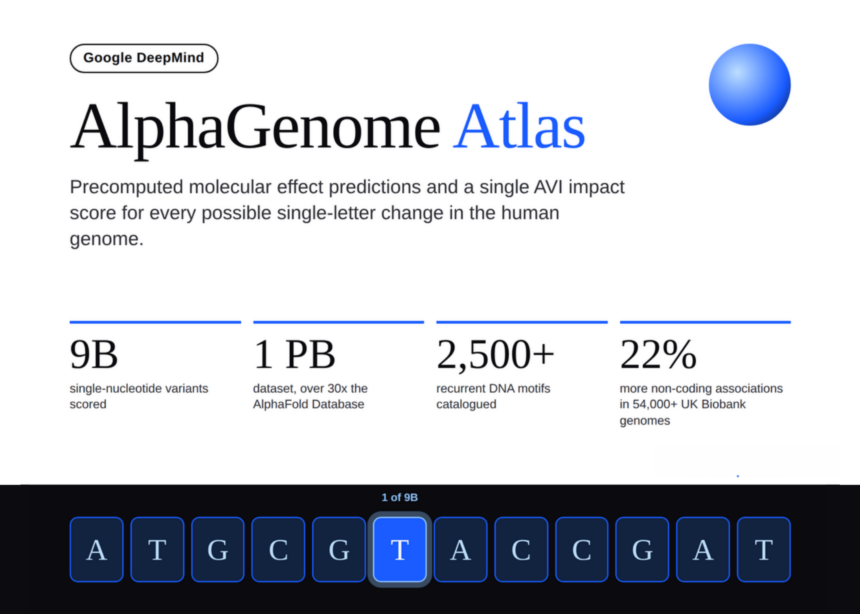
A New Frontier in Genomic Precision
Google DeepMind has unveiled the AlphaGenome Atlas, a monumental resource that transforms how researchers interact with the human genome. By precomputing the molecular consequences of every possible single-nucleotide variant across the entire human genome, this project cataloging roughly 9 billion distinct genetic variations offers an unprecedented, high-resolution predictive map.
The core of this release is not just the data, but the introduction of the AlphaGenome Variant Impact (AVI) score. This metric provides a standardized, single-number assessment of a variant’s biological influence, bridging the gap between functional genomics and clinical research. Furthermore, the Atlas simplifies interpretation by offering variant-specific feature attributions and a comprehensive collection of genome-wide motifs.
Scaling Genomic Insights: From Model to Atlas
While the original AlphaGenome model, released in June 2025, provided powerful predictive capabilities, it was restricted by its sequential nature—researchers had to query specific variants one by one. This approach was computationally prohibitive for large-scale studies. The Atlas fundamentally shifts this paradigm. By running the AlphaGenome model across all 9 billion variants and storing the resulting interpretations, DeepMind has generated a 1-petabyte dataset. This repository is vast, dwarfing the AlphaFold Database by a factor of 30.
What the AlphaGenome Atlas Offers
- Predictive Molecular Effects: Access to thousands of regulatory predictions covering RNA splicing, gene expression, and chromatin accessibility across diverse tissues.
- The AVI Score: A unified impact metric that integrates regulatory predictions with AlphaMissense, ensuring effective scoring for both coding and non-coding DNA.
- Interpretability Through Attribution: Each AVI score is decomposed into additive feature contributions, allowing researchers to isolate which biological mechanisms—such as splicing or accessibility—a variant likely disrupts.
- Regulatory Motifs: A library of over 2,500 recurring DNA sequence motifs with precise genomic mapping, facilitating deeper understanding of transcription factor binding sites.
Validated Real-World Applications
The impact of this resource is already being felt through early access research collaborations:
| Research Area | Primary Finding |
|---|---|
| Rare Disease | Identified a critical DNM1 variant causing abnormal RNA splicing, validated through experimental screens. |
| Population Genetics | Found 22% more non-coding associations in 54,000+ UK Biobank participants compared to traditional approaches. |
| Regulatory Grammar | Differentiated between transcription factors that specifically drive accessibility versus gene activation. |
How to Access the AlphaGenome Resource
DeepMind has optimized the accessibility of this data for the scientific community, though it is important to note that the current release is designated for research purposes and does not carry clinical approval.
- Web Portal: A user-friendly, free interface for academic exploration.
- API Access: Direct programmatic integration via the AlphaGenome API.
- Google Antigravity: The Atlas is integrated as a functional skill within the Google Antigravity platform.
- Cloud Integration: While current access focuses on academic use, commercial-grade access on Google Cloud is slated for release in the near future.
The AlphaGenome Atlas represents a shift toward “lookup-based” genomics, where the bottleneck of massive computational cost is bypassed by precomputing and indexing the entire landscape of human genetic variation.