
Redefining GPU Programming: NVIDIA’s Leap into Rust
For years, the intersection of high-performance GPU computing and memory safety has been a challenging landscape. NVIDIA has officially taken a major step toward bridging this divide with the announcement of CUDA Rust, an initiative that integrates Rust natively into the CUDA ecosystem. By moving away from purely C++-based kernels, NVIDIA is providing developers with the tools to write GPU-accelerated code that leverages Rust’s strict memory ownership model to prevent common concurrency and memory-safety issues at compile time.
The Two-Track Architectural Approach
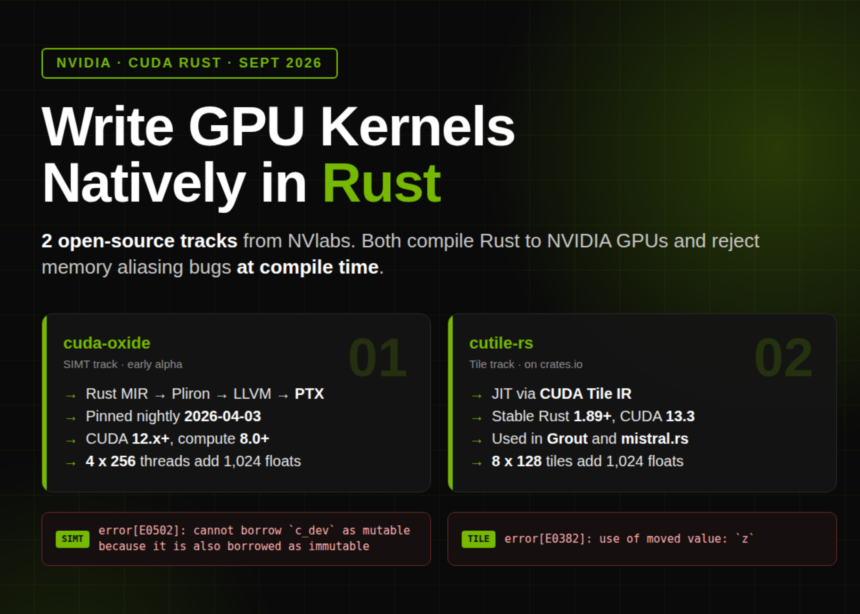
Rather than a one-size-fits-all solution, NVIDIA has introduced two distinct tracks for writing Rust-based GPU kernels, catering to different programming models:
- cuda-oxide (SIMT Track): This track utilizes the traditional Single Instruction, Multiple Threads (SIMT) model. It operates as a custom
rustccodegen backend, taking Rust MIR (Mid-level Intermediate Representation) and passing it through the Pliron IR framework to generate high-performance PTX code. - cutile-rs (Tile Track): Representing a more modern abstraction, this track follows the Tile programming model. Instead of managing low-level thread indexing, developers focus on data tiles. The compiler manages the underlying thread mapping, providing a simpler, more robust interface that is already seeing adoption in production environments like Hugging Face’s Grout inference engine.
Safety Through Ownership
The primary advantage of bringing Rust to the GPU is the enforcement of safety via the compiler. In traditional C++ CUDA, it is easy to accidentally introduce aliasing bugs—where multiple threads attempt to write to the same memory location incorrectly. CUDA Rust mitigates this:
- cuda-oxide uses a
DisjointSlice<f32>type. This forces developers to structure their kernels so that each thread is granted exclusive access to its specific segment of data, which the borrow checker enforces. - cutile-rs adopts a strategy where the host-side launcher takes ownership of input tensors. This ownership model ensures that tensors cannot be accessed while the GPU is processing them, and they are only returned to the host once the operation is fully synchronized.
Comparison of the Two Tracks
The following table outlines the technical prerequisites and architectural trade-offs between the two approaches currently offered by NVIDIA:
| Feature | cuda-oxide (SIMT) | cutile-rs (Tile) |
|---|---|---|
| Status | Early Alpha | Published (Crates.io) |
| Toolchain | Pinned Nightly Rust | Stable Rust 1.89+ |
| Compilation | Ahead-of-Time to PTX | JIT via CUDA Tile IR |
| Safety Mechanism | DisjointSlice + Contract Validation | Partitioned Tensor Ownership |
| Shared Memory | Manual (Requires Unsafe) | Compiler-Managed |
Looking Ahead
While cuda-oxide is currently in an experimental phase, requiring specific nightly toolchains and clang dependencies, the Tile-based cutile-rs approach offers a more streamlined, developer-friendly experience. Both projects demonstrate a clear path toward a future where developers can combine the raw speed of NVIDIA GPU hardware with the architectural reliability of the Rust programming language. Developers should note that both implementations are currently in active development, but the tooling is sufficiently advanced for experimentation in system-level AI software.