
The New Standard for Secure AI Development
In the evolving landscape of autonomous software engineering, the ability for an AI to interact with a filesystem and execute arbitrary code is no longer a luxury; it is a baseline requirement. However, this level of agency introduces significant security risks. Google’s recent release of Mantis offers a sophisticated, modular approach to managing this vulnerability lifecycle without forcing developers to build every defensive component from scratch.
Understanding the Mantis Framework
Mantis is not a monolithic security scanner. Instead, it functions as a comprehensive toolkit—a library of security review skills designed to be integrated directly into your existing AI agent workflows. By utilizing a series of specialized slash commands, developers can chain together modular functions that cover everything from threat modeling to patch verification.
The framework operates on a strict principle: isolation and verification. Mantis mandates that agents operate within restricted sandboxes, ensuring that when an agent attempts to reproduce a vulnerability, it does so without risking production systems or internal network integrity.
The Core Operational Pipeline
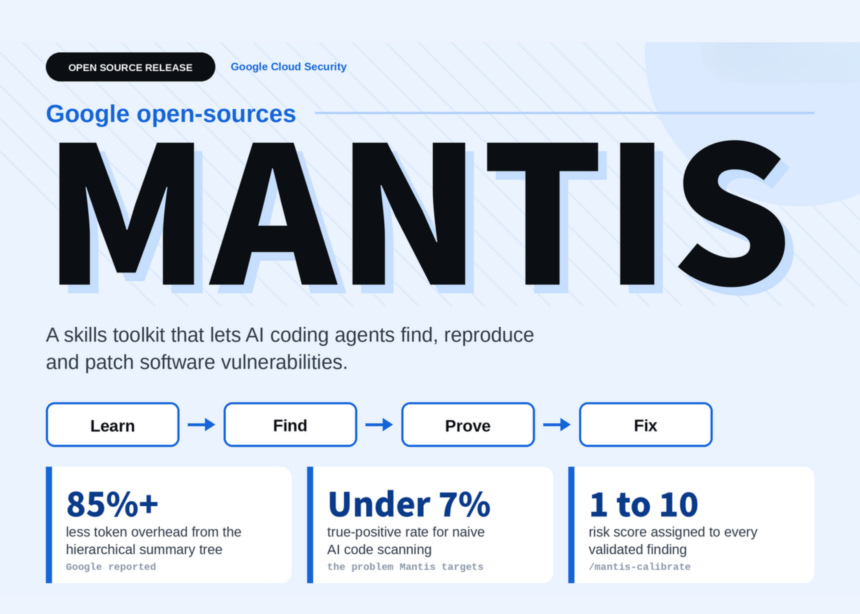
The Mantis architecture is built on a modular pipeline where each stage is a distinct skill. These skills are organized into four primary functional categories:
- Learning: Using commands like
/mantis-historyand/mantis-threat-model, the agent builds a contextual knowledge base, extracting trust boundaries and historical bug patterns rather than ingesting raw code blindly. - Discovery & Filtering: The agent sweeps the codebase using
/mantis-researcher. Crucially, subsequent steps like/mantis-reviewand/mantis-criticapply rigorous negative rules to filter out false positives and ensure issues are viable in production builds. - Verification & Proof: This is the framework’s differentiator. Using
/mantis-reproduce, the agent attempts to trigger the vulnerability within a sandboxed, network-restricted environment. It then uses/mantis-chainto confirm complex exploit chains. - Remediation: Once a finding is validated,
/mantis-patchgenerates and verifies a fix. The agent then re-attacks its own patch to ensure the vulnerability has been truly eliminated.
Key Technical Advantages
Mantis addresses two primary bottlenecks in autonomous security review: token overhead and true-positive reliability.
Google reports that utilizing their hierarchical summary tree architecture reduces token overhead by more than 85 percent compared to traditional brute-force repository ingestion. By summarizing directories and focus areas first, agents maintain architectural context while minimizing expensive API costs.
Furthermore, the tool explicitly addresses the industry challenge of naive AI security scanners that suffer from extremely low true-positive rates—often under 7 percent. By grounding findings in successful, sandboxed reproduction (Proof of Concept), Mantis forces the agent to prove its work before flagging an issue.
Strategic Implementation
While Mantis provides a robust architecture, it remains a tool for local and internal testing. Developers should note that the framework generates and executes autonomous code. Therefore, it is essential to run Mantis strictly within isolated, non-production environments with no access to sensitive data or internal credentials.
For teams looking to refine their agentic workflows, Mantis serves as a blueprint for how to transition from simply “having an agent write code” to “having an agent systematically secure the entire software development lifecycle.”