
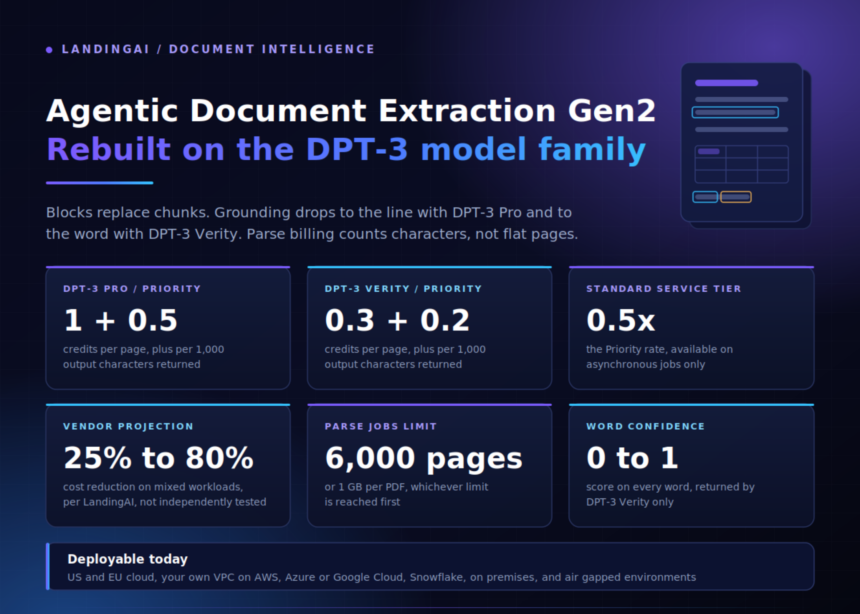
The Evolution of Intelligent Document Processing
LandingAI has unveiled its next-generation document intelligence suite, Agentic Document Extraction (ADE) Gen2. By shifting from a flat, chunk-based architecture to a tree-structured parsing model, this release signals a move toward higher precision and more manageable costs for enterprise-grade automated workflows. Built on the new DPT-3 model family, the architecture emphasizes atomic grounding, ensuring every extracted data point can be mapped back to its exact origin within a source file.
Understanding the DPT-3 Architecture
Unlike its predecessor, which viewed documents as unstructured collections of chunks, Gen2 treats the document as an ordered, hierarchical tree. This approach allows the system to differentiate between varied layout elements, such as tables, figures, stamps, and signatures. LandingAI has bifurcated the parsing model into two distinct specialized engines:
- DPT-3 Pro: Optimized for complex layouts, scanned documents, handwriting, LaTeX mathematics, and non-Latin scripts. It establishes the layout structure before transcribing content.
- DPT-3 Verity: A deterministic model designed for high-volume, digitally created documents. It provides per-word bounding boxes and confidence scores, offering a cost-efficient alternative for structured data extraction.
Financial Re-engineering: The Character-Based Model
The most significant shift in ADE Gen2 is the transition from a flat, per-page credit billing model to a hybrid consumption metric. Costs are now determined by both the document volume and the quantity of data returned. By aligning billing more closely with actual utility—the characters returned rather than a blanket per-page fee—LandingAI aims to provide more predictable costs for varying document densities.
| Model | Service Tier | Page Credit (Fixed) | Character Credit (per 1k) |
|---|---|---|---|
| DPT-3 Pro | Priority | 1.0 | 0.5 |
| DPT-3 Pro | Standard | 0.5 | 0.25 |
| DPT-3 Verity | Priority | 0.3 | 0.2 |
| DPT-3 Verity | Standard | 0.15 | 0.1 |
Atomic Grounding and Semantic Stability
At the core of the Gen2 platform is atomic grounding, which provides granular traceability for every extracted block. The system produces a structured response containing:
- Markdown output: Provided in logical reading order.
- Structure metadata: Hierarchical nodes defining pages and blocks (e.g., text, table, figure, card, scan_code).
- Semantic ID stability: IDs remain consistent throughout a single response, facilitating easier downstream integration.
- Grounding objects: Every leaf node includes a reference to its specific page, markdown string range, and normalized bounding box.
For DPT-3 Verity, these confidence scores operate on a 0 to 1 scale per word. This allows development teams to build automated triggers that route low-confidence segments directly to human reviewers, significantly reducing the surface area for errors.
Deployment and Migration
ADE Gen2 is available now with support for multi-cloud environments, including AWS, Azure, and Google Cloud, as well as on-premises and air-gapped installations. Developers should note that the transition to Gen2 introduces breaking changes; previous integration code developed for Gen1 will not function with the new API endpoints. While existing extraction schemas built on V1 are compatible, the migration requires updating integration logic to handle the new tree-structured response formats.