
The Rise of Edge-Ready Language Models
The push for artificial intelligence to transition from centralized data centers to local devices has reached a new milestone. OpenBMB has introduced MiniCPM5-2B, a dense, causal large language model (LLM) designed specifically for on-device deployment. With approximately 2.52 billion parameters, the model demonstrates that compact architectures, when trained with a rigorous and innovative data recipe, can punch well above their weight class in specific operational domains.
Architecture and Model Specs
MiniCPM5-2B utilizes a standard LlamaForCausalLM architecture, which ensures broad compatibility with existing inference engines such as vLLM, SGLang, Transformers, llama.cpp, Ollama, LM Studio, MLX, and FlagOS. This choice of architecture allows developers to leverage existing infrastructure without the need for model-code forks or custom kernel implementations.
The model architecture is defined by the following characteristics:
- Parameter Count: ~2.52 billion total parameters, with 1.98 billion excluding embeddings.
- Depth: 42 layers.
- Attention Mechanism: Grouped-query attention utilizing 16 query heads and 2 key/value heads.
- Context Window: A robust native 131,072-token context window.
- Licensing: Apache 2.0.
Benchmark Performance Analysis
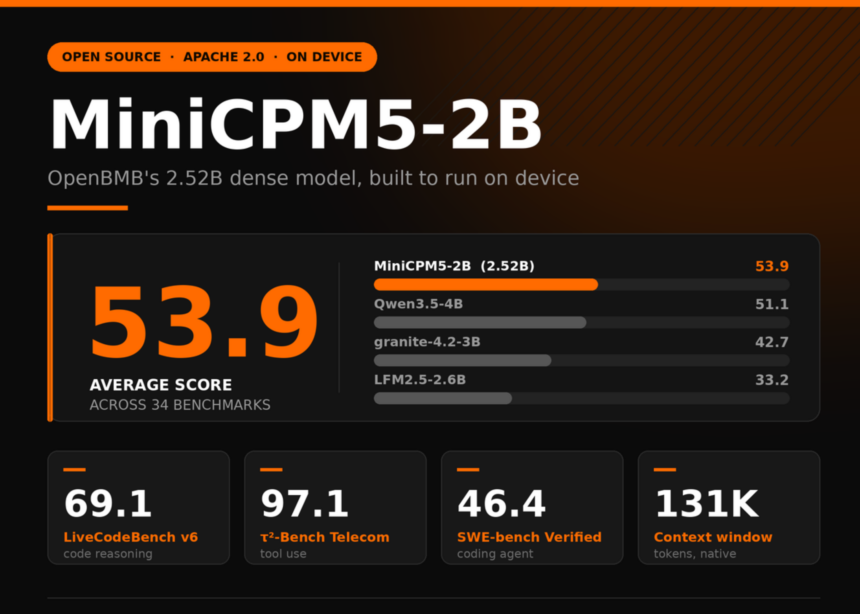
OpenBMB evaluated the model against a variety of peers in the 2-4 billion parameter range. When looking at the aggregate performance across 34 specific benchmark tasks, MiniCPM5-2B achieved an average score of 53.9. This performance notably outpaces the 4-billion parameter Qwen3.5-4B, which recorded a 51.1, and several other compact alternatives.
| Model | Avg Score (34 Benchmarks) |
|---|---|
| MiniCPM5-2B | 53.9 |
| Qwen3.5-4B | 51.1 |
| granite-4.2-3B | 42.7 |
| LFM2.5-2.6B | 33.2 |
| Qwen3.5-2B | 28.0 |
The model’s strengths are not uniform across all domains. It displays superior capabilities in tool utilization, coding agents, and long-context retrieval, where it significantly outperforms larger models. However, it shows expected limitations in general knowledge tasks, such as MMLU-Pro or humanities-focused examinations, where larger parameter counts still offer a distinct advantage.
The Training Strategy: A Tiered Approach
The performance profile of MiniCPM5-2B is attributed to a multi-stage training pipeline, centered on the “UltraData” management methodology. The process is broken down into five distinct phases:
- Base Training: Focuses on stability and decay phases using the Ultra-FineWeb and UltraX corpora.
- Mid-Training: Adapts the model for specific distributions like code and math.
- SFT: Utilizes 400 billion tokens of deep-thinking supervised fine-tuning data.
- RL: Employs the “JustRL II” algorithm to train specialized teachers for reasoning, writing, and agentic behaviors.
- On-Policy Distillation (OPD): This final step merges 16 different RL experts into a single, cohesive model by calculating reverse KL divergence between the student and teacher logits.
Deployment Considerations
By releasing the weights alongside the training data—including the Ultra-FineWeb and various UltraData collections—OpenBMB has provided a high degree of transparency. The model serves as a specialized tool for edge-based agentic workflows. Because it is highly optimized for tool calls and specific agentic tasks, it serves as a highly efficient, lower-latency alternative to larger, general-purpose models for developers building on-device applications.