
Solving the Hardware Interoperability Crisis
In modern research environments, the physical world often acts as a bottleneck for digital intelligence. A typical lab or industrial automation cell is a chaotic mosaic of specialized equipment—microscopes, liquid handlers, and robotic arms—sourced from diverse vendors that never intended to play nicely together. Traditionally, engineers spent weeks, or even months, writing bespoke, fragile translation scripts to bridge these disparate devices. This reality creates a massive drag on development velocity.
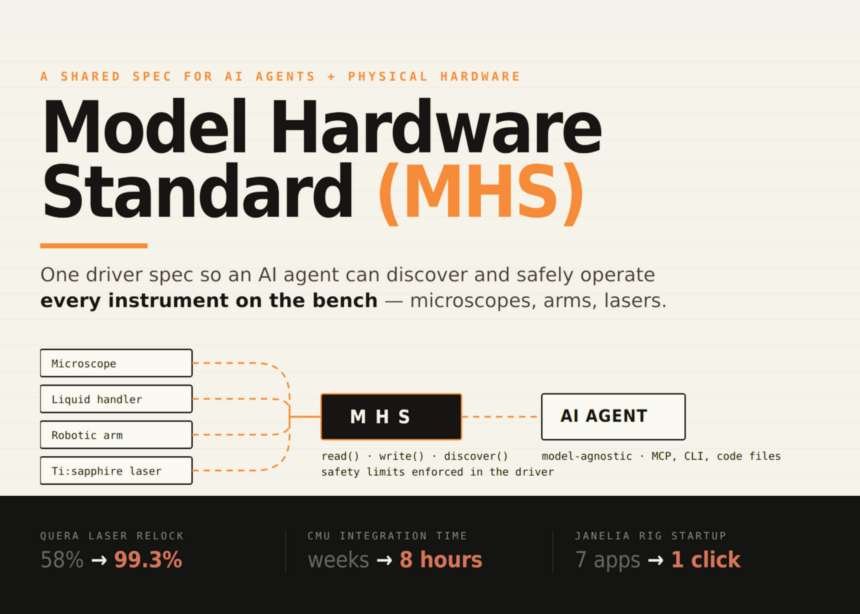
Anthropic’s newly released Model Hardware Standard (MHS) aims to solve this by providing a unified, shared specification for AI agents to discover and control physical hardware. By standardizing the driver layer, MHS allows devices to expose a consistent set of capabilities, enabling agents to operate them securely and autonomously.
The Mechanics of MHS: Standardized Control
At its core, MHS treats the driver as a common interface between an operating system and a hardware component. Instead of custom APIs for every tool, the standard mandates a set of universal primitives:
- read(): To query device sensors or status.
- write(): To issue commands or adjust parameters.
- discovery(): To allow devices to broadcast their presence on a network, enabling plug-and-play agent interaction.
Beyond basic operations, MHS incorporates metadata about the physical device that code typically misses—such as the payload limits of a robotic arm or environmental constraints. Users (or agents via natural language interviews) define these as driver tags. These tags are then compiled into a reference file that encodes exactly what a device measures, how it can be adjusted, and, crucially, where the hardware safety limits reside.
Proven Performance Gains
The research preview highlights significant operational improvements across diverse use cases, ranging from quantum computing to high-throughput biology.
| Application | Baseline Performance | MHS-Enabled Performance |
|---|---|---|
| QuEra Laser Relock | 58% success at ~150s per attempt | 99.3% success across 700 trials |
| CMU Lab Integration | Several weeks (vendor-based) | 8 hours (full setup to experiment) |
| Specialist Servo Tuning | 15.7 mV residual error | 1.55 mV residual error |
In the QuEra case, the agentic implementation replaced a hand-built script with a deterministic Python loop that recovered the laser lock in 10–14 seconds—dramatically faster than the 5-10 minutes often required by human operators. Furthermore, at Carnegie Mellon University, researchers were able to integrate six disparate instruments into an autonomous dose-response experiment cycle within a single day, an order-of-magnitude reduction in setup time.
Security and Safety Integration
A critical architectural feature of MHS is that safety constraints are enforced at the driver level, rather than relying on the agent’s prompt or reasoning capabilities. If an agent attempts to issue a command that violates physical safety boundaries, the driver rejects the instruction before any mechanical movement occurs. The standard is designed to be model-agnostic, meaning any agent harness can interface with the hardware using familiar tools like the Model Context Protocol (MCP), a command-line interface, or static code files.
Summary of Findings
- Efficiency: Integration timelines collapse from weeks to a single workday.
- Reliability: Deterministic scripts generated by agents often outperform manual scripts in stability.
- Safety: Hard-coded safety limits provide a robust barrier against agent hallucinations.
- Accessibility: The system is model-agnostic and maintains compatibility with standard communication protocols.
While the MHS represents a massive leap forward in physical AI, it remains in a research preview phase. It still requires human supervision, as the model’s physical world-reasoning capabilities can still exhibit edge-case failures. Nevertheless, by abstracting away the “integration tax,” MHS provides a foundational layer for the next generation of physical-world autonomous agents.