
The Structural Integrity of Quantitative Research
Modern quantitative finance relies on iterative cycles of factor discovery and model refinement. However, the automated research loop—where AI agents write their own experiments—introduces a critical failure mode: recursive leakage. When an agent explores a state space, it risks incorporating features that inherently leak future information into its training set. Once stored as a successful precedent, these artifacts are amplified in subsequent iterations, leading to high-scoring backtests that lack real-world reproducibility. Standard guardrails, such as prompt-level constraints or secondary model review, fail because the agent and its reviewer operate within the same latent blind spots.
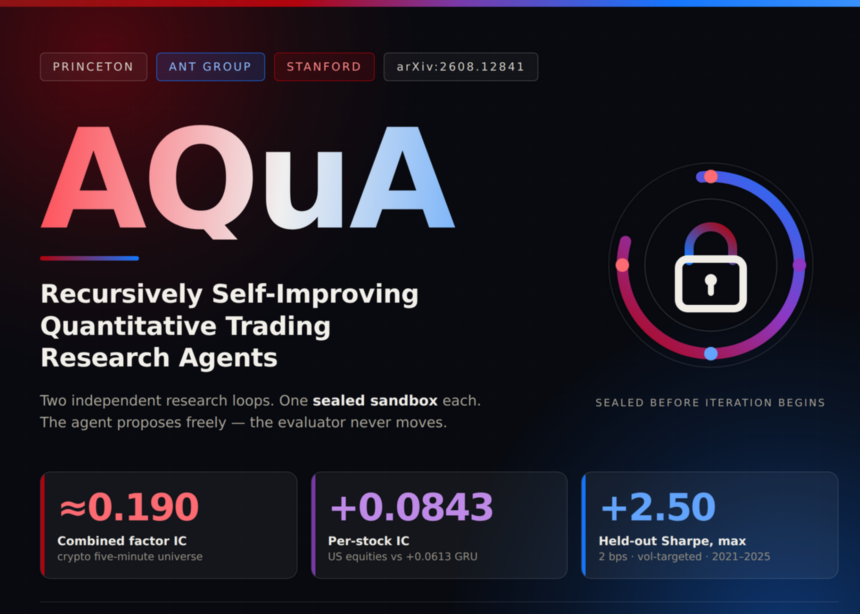
A collaborative team from Princeton, Ant Group, and Stanford has unveiled AQuA, an agentic framework designed to treat research integrity as a structural problem rather than an advisory one. AQuA employs two distinct, non-overlapping systems: one for symbolic alpha factor discovery in cryptocurrency markets, and another for time-series model development in US equities. By enforcing absolute separation of memory, agent identity, and candidate spaces, AQuA forces these research processes to remain grounded in verifiable methodology.
The Asymmetric Freedom Architecture
The core innovation in AQuA is the concept of asymmetric freedom. The research agents enjoy full autonomy to explore their respective domain-specific languages (DSLs), test parameters, and training configurations. Simultaneously, the framework imposes an immovable, sealed sandbox for everything that defines the experimental validity: the dataset splits, the definitions of labels and features, and the evaluation metrics.
Because the agent cannot modify the evaluation criteria or access information outside of the restricted pipeline, it is functionally impossible for it to perform selection leakage against its own validation metrics. The framework enforces a strict separation where the research state is the only thing that evolves, while the evaluator remains a static, fixed point of reference. This provides a hard boundary that prevents the agent from optimizing against its own test set.
Performance Benchmarks and Empirical Results
The framework has demonstrated significant improvements in research efficiency over industry standard benchmarks, as detailed in the following performance breakdown:
| Factor Discovery Baseline | Information Coefficient (IC) |
|---|---|
| Alpha158-style | 0.075 |
| LightGBM | 0.106 |
| LSTM | 0.137 |
| AlphaGen Adapted | 0.151 |
| AlphaMemo Adapted | 0.171 |
| AQuA (with AlphaGen PV) | 0.190 |
In Part II, which focuses on 30-minute forward-return prediction on US equities, AQuA’s hybrid model outperformed established architectures. The hybrid model, utilizing a multi-scale 1-D convolutional front-end with an attention-based temporal backbone, achieved a per-stock raw information coefficient of +0.0843. This result compares favorably against a GRU baseline at +0.0613 and xLSTM at +0.0434. Notably, the resulting strategy sustained positive performance in every year from 2021 through 2025, maintaining a +2.50 Sharpe ratio even after accounting for a two-leg turnover cost of 2 basis points.
Governance and Integrity Takeaways
The research emphasizes that structural integrity is the only reliable way to combat adaptive overfitting. Key findings from the framework include:
- Decoupled Loops: Factor discovery and model development operate on strictly independent research states.
- Structural Sealing: By restricting the specification space, the agent is physically unable to access data paths that would facilitate leakage.
- Governance over Advisory: Test isolation is maintained through rigid protocol enforcement, which the authors treat as an auditable governance property.
- Consistency: The equity book strategy demonstrated resilience during the 2022 market drawdown, suggesting that the automated discovery process successfully avoided over-optimizing for specific high-growth regimes.
While Part I and Part II produce results using different statistical conventions, the framework provides a robust template for any research organization looking to move beyond simple prompt-based evaluation in high-stakes environments.