
Rethinking Data Acquisition: Moving Beyond the Seed Corpus
For years, the standard operating procedure for training robust AI models has been predicated on the availability of a massive, pre-existing corpus of data. Engineers would spend the majority of their development cycle hunting for relevant logs, cleaning unstructured text, and painstakingly crafting labeling guidelines to turn messy data into something usable. This approach inherently caps model performance, as you are limited by the quality and availability of the data you already possess.
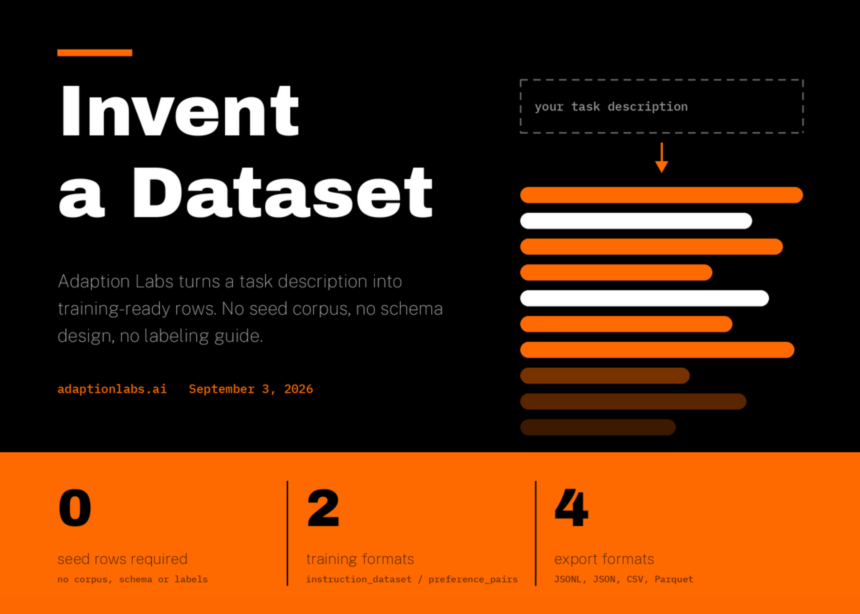
Adaption Labs has challenged this paradigm with their latest release, Invent a Dataset. Instead of asking you to bring your own massive seed corpus, they have created a service that generates high-fidelity, training-ready datasets directly from a plain-text description of the desired behavior. The platform effectively moves the effort from data curation to intentional behavioral definition.
The Core Mechanism: How Invent a Dataset Operates
The architecture of the service is designed for integration into modern machine learning pipelines, providing both a Python SDK and a REST API. The process begins with an asynchronous request, allowing developers to integrate data generation into larger automated workflows without blocking execution.
You can interact with the service by querying its domain registry to find relevant operational areas. By using the datasets.invent endpoint, you provide a prompt defining the task, select your domain and subdomains, and specify the desired training structure. The system polls for completion, and once the task is finished, you receive an artifact that is ready for immediate injection into your training pipeline in formats such as JSONL, JSON, CSV, or Parquet.
Configuring the Generation Pipeline
The platform provides specific controls to ensure the generated data aligns with production requirements:
- Domain-Specific Targeting: Rather than broad generation, you can target specific subdomains, such as
medical.symptoms_diagnosis, to ensure the resulting dataset has the appropriate technical depth. - Format Flexibility: You can output
instruction_datasetrows for classic supervised fine-tuning orpreference_pairsfor more advanced training techniques like Direct Preference Optimization (DPO). - Production Safety: Using the
estimate=Trueparameter allows teams to validate costs and resource requirements before triggering a full generation run, ensuring budgetary compliance. - Idempotency: By providing an
idempotency_key, you can safely retry network calls without the risk of duplicate runs or redundant billing.
Internationalization and Localization
A critical challenge in modern AI development is creating models that perform well across different locales. Invent a Dataset addresses this through its language_expansion capabilities. You have the choice of two primary modes:
- Translation: Generates direct variants of your dataset in selected target languages.
- Localization: Produces locale-aware variations that account for regional vocabulary and cultural nuances rather than simple linguistic swaps.
Closing the Loop with AutoScientist
The true utility of this approach is realized when the generated data is consumed by AutoScientist, Adaption’s co-optimization engine. This creates a tight feedback loop where the synthetic data and the training recipe are tuned simultaneously. Adaption reports significant gains through this workflow, with average win rates increasing from 48% to 64% across a variety of specialized domain benchmarks. By automating both the data creation and the optimization process, teams can shift their focus from dataset management to product intent.
Key Technical Features
| Feature | Description |
|---|---|
| Input Method | Task-based descriptions (No seed corpus required) |
| Output Formats | JSONL, JSON, CSV, Parquet |
| Safety Mechanism | Idempotency keys and cost estimation |
| Training Compatibility | Native integration with AutoScientist |
| Expansion Modes | Direct translation and context-aware localization |