

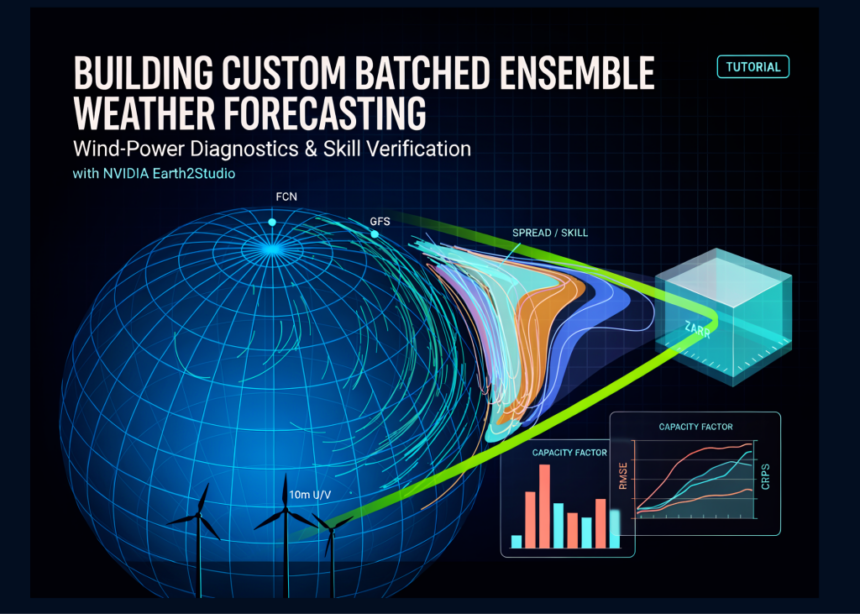
Revolutionizing Weather Prediction with NVIDIA Earth2Studio
Modern meteorology is shifting from expensive, traditional numerical weather prediction (NWP) models toward high-speed, data-driven AI solutions. A significant leap in this transition is NVIDIA Earth2Studio, a comprehensive framework designed to simplify the construction of custom weather-forecasting workflows. By leveraging modern deep learning models, developers can now build sophisticated ensemble pipelines that were previously reserved for massive supercomputing centers.
Core Architectural Pillars
The strength of Earth2Studio lies in its modular design, which allows researchers to integrate different prognostic models and diagnostic tools seamlessly. Key components of a high-fidelity ensemble workflow include:
- Atmospheric Initialization: Direct retrieval of initial conditions from reliable sources like the Global Forecast System (GFS).
- Custom Diagnostics: The ability to inject domain-specific models, such as converting wind speeds into real-world energy production capacity.
- Physically Constrained Perturbations: Implementing noise systems that account for the unique characteristics of different atmospheric variables, rather than applying generic, uniform noise.
- Coordinate-Aware Data Management: Utilizing Zarr for high-performance, parallel storage that maintains full spatial and temporal metadata.
Constructing the Ensemble Pipeline
Building a robust ensemble system requires more than just running a base model multiple times. It involves a systematic approach to batching and coordinate mapping. By using the Earth2Studio iterator and batching APIs, developers can efficiently manage resources, even when running on standard cloud-based GPU instances.
The following approach highlights how to implement a custom wind-power diagnostic and a variable-scaled perturbation system:
# Implementing a custom wind power capacity factor diagnostic
class WindPowerCF(torch.nn.Module):
    def __init__(self, lat, lon, hub=100.0, alpha=0.143, cut_in=3.0, rated=12.0, cut_out=25.0):
        super().__init__()
        # Logic to map 10m wind to turbine hub-height wind speed
        ...
    def __call__(self, x, coords):
        # Calculate power curve capacity factor [0, 1]
        ...
Evaluation and Uncertainty Quantification
An ensemble is only as useful as its ability to communicate uncertainty. Rather than providing a single “best guess,” this architecture produces a range of scenarios. Verification should be grounded in rigorous statistical metrics:
- Latitude-Weighted RMSE: Ensures spatial accuracy is not skewed by grid-point density at the poles.
- Fair CRPS: Provides a robust, unbiased measure of probabilistic forecast quality.
- Spread-Skill Analysis: Monitors whether the ensemble dispersion accurately reflects the actual forecast error, confirming whether the system is well-calibrated.
Visualizing Forecast Success
Visualization serves as the final step in translating complex multi-dimensional data into actionable insights. By generating spatial maps for the ensemble mean and spread, geopotential-height spaghetti plots for synoptic patterns, and point-based fan charts for specific locations, teams can intuitively grasp the reliability of upcoming weather patterns. This capability is essential for sectors—such as renewable energy—that rely heavily on accurate, uncertainty-aware forecasting to manage grid volatility.
By following Earth2Studio’s component-based interface, these pipelines become highly extensible. Developers can easily swap out prognostic models or add new diagnostic metrics without needing to re-engineer the entire system, ensuring that the infrastructure evolves alongside the latest AI research.