
The Evolution of Intelligent Document Processing
In the high-stakes world of enterprise data, the bottleneck is rarely the language model itself, but rather the quality of the input. Converting dense, visual-heavy enterprise documents like invoices, contracts, and insurance filings into machine-readable text has historically required a fragmented, error-prone pipeline of OCR, layout analysis, and manual data cleanup. Cohere has addressed this directly with the release of Parse 5 (parse-v5.0).
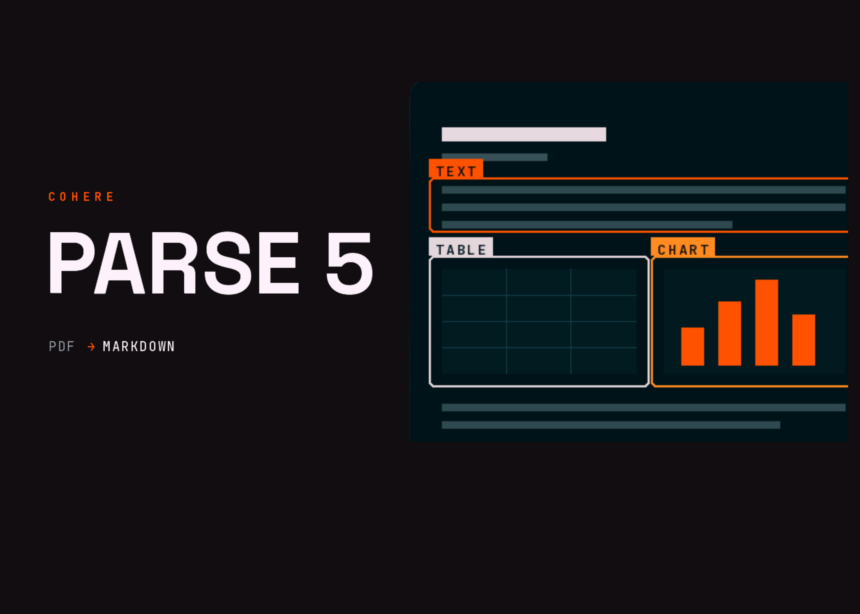
Unlike traditional pipelines that treat layout understanding as a separate, pre-OCR task, Parse 5 is a specialized 2.3B-parameter vision language model. By training a model specifically to treat documents as visual objects rather than plain text streams, Cohere is enabling a single-pass workflow that directly outputs structured Markdown and HTML-rendered tables, complete with bounding box coordinates for every significant element.
Technical Architecture and Capabilities
At its core, Parse 5 leverages the North-Micro-Vision-Instruct architecture. It is built to be efficient, maintaining a relatively lean footprint of approximately 4.6GB while providing an 8,192-token context window. This architecture allows the model to handle not just standard text, but complex document features simultaneously:
- Reading Order Preservation: Instead of extracting text in raw stream order, the model reconstructs the document based on how a human navigates the layout.
- Table Rendering: Complex data tables are converted into HTML format rather than flattened, ensuring that headers and nested relationships remain intact.
- Form Understanding: The model excels at identifying keys and their corresponding values in unstructured forms, which is critical for automated claims and invoice processing.
- Multi-modal Output: It provides image descriptions and spatial coordinates (bounding boxes), making the output fully traceable back to the source image.
Performance Benchmarking: A Realistic View
Cohere has reported a ParseBench score of 79.2. It is vital for software architects to understand what this number represents. ParseBench evaluates parsers across five critical dimensions: table structure, content faithfulness, semantic formatting, visual grounding, and chart interpretation. Cohere’s reported figure averages three of these dimensions, excluding chart and visual grounding, which are traditionally the most difficult metrics for parsers. For comparison, the broader LlamaIndex-maintained leaderboard, which calculates scores across all five categories, currently lists other enterprise solutions between 59 and 61, with top performers in the 84+ range. Prospective users should utilize this release to benchmark their own specific document schemas rather than relying solely on the vendor-reported aggregate.
Economic and Deployment Considerations
The pricing strategy for Parse 5 is designed for high-scale document ingestion. At $1.50 per 1,000 pages, it is aimed at companies that need to process millions of documents without incurring the massive overhead of general-purpose model token consumption.
| Deployment Tier | Price | Unit |
|---|---|---|
| Metered API | $1.50 | Per 1,000 pages |
| Model Vault (Medium) | $2,500.00 | Per month (Flat) |
| Model Vault (XL) | $4,300.00 | Per month (Flat) |
For engineering teams assessing the transition from metered billing to dedicated capacity via Model Vault, the crossover point is significant. A single Medium instance generally becomes the more cost-effective option only after exceeding 1.67 million pages per month. For most mid-market enterprise applications, the metered API model will offer superior agility. Model Vault is best reserved for scenarios requiring strict data residency, air-gapped environments, or extreme throughput that would otherwise hit API rate limits.
Strategic Deployment Scenarios
Parse 5 is currently available for production use across multiple deployment paths, including AWS SageMaker, Microsoft Foundry, and Cohere’s proprietary Model Vault. It is particularly well-suited for RAG pipelines where document structure is the primary cause of retrieval failure. By converting messy PDFs into clean Markdown chunks, the system significantly improves the precision of downstream embedding models. For architects building agentic workflows, the output_format="blocks" setting is the recommended path, as it provides the necessary typed metadata—such as bounding boxes and HTML strings—required for agents to perform precise, citation-backed reasoning over complex documents.