
Google Advances Multimodal Video Generation with Gemini Omni 1.1 Flash
Google has officially introduced Gemini Omni 1.1 Flash, a significant iteration in its native multimodal video generation stack. Moving beyond simple text-to-video capabilities, this release positions the model as a highly directed tool for creative production, offering granular control over camera movement, frame continuity, and asset composition via the Gemini API.
The architecture is built on the foundation of native multimodality, enabling the concurrent processing of text, audio, images, and video. This integration facilitates a stateful editing loop, allowing developers to manipulate existing video clips without needing to re-upload assets. By passing a previous_interaction_id, the model processes subsequent edits while maintaining coherence in areas of the video that were not specifically modified.
Advanced Directing and Scene Composition
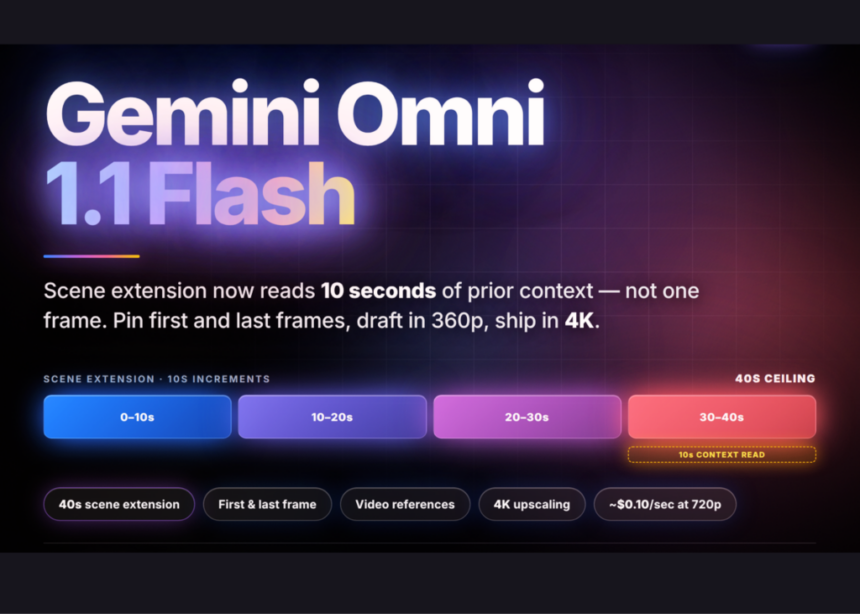
One of the most impactful architectural updates is the enhancement of scene extension. Previous versions of video models were limited to referencing the final frame, which often resulted in temporal drift. Gemini Omni 1.1 Flash now reads up to 10 seconds of historical context. This improvement enables more stable generation of motion, character consistency, and audio alignment across an extension ceiling of 40 seconds, rendered in increments of 10 seconds.
Developers now have precise control over camera trajectories through first and last frame pinning. By utilizing tags such as <FIRST_FRAME> and <LAST_FRAME>, the model generates smooth interpolation between two specific states. This, combined with character or object reference capabilities using <VIDEO_REF_N> tags, allows for complex creative sequences that were previously difficult to prompt effectively.
Performance, Resolution, and Economic Efficiency
Google has implemented a tiered rendering strategy to help developers manage inference costs and throughput. The system supports native 360p draft rendering, which produces outputs up to 60% faster and at one-third the cost of 720p generation. High-fidelity requirements are met through internal upscaling, with the model providing options for 1080p and 4K outputs.
The pricing structure reflects a clear focus on token-based consumption:
| Resource | Pricing / Metric |
|---|---|
| Input | $1.50 per 1M tokens |
| Output (Text) | $9.00 per 1M tokens |
| Output (Video) | $17.50 per 1M tokens |
| Effective Rate (720p) | ~$0.10 per second |
Deployment Constraints and Provenance
While powerful, the model operates within specific production boundaries. It does not currently support temperature, top_p, or negative prompts as separate parameters—negative constraints must be integrated directly into the prompt text. Furthermore, audio references and voice editing are not supported, and editing functionality is regionally restricted in the EEA, Switzerland, and the UK.
For security and provenance, every asset generated by Gemini Omni 1.1 Flash is embedded with SynthID watermarking. This is designed to be imperceptible to the human eye while providing programmatic verification, ensuring that the origins of AI-generated content can be traced within enterprise workflows.
The model is currently accessible via the Gemini Enterprise Agent Platform and Google AI Studio, with early production adoption noted by organizations like Adobe, Figma, and Runway.