
The Evolution of Precision: WeatherNext 3
For years, the field of AI-driven weather forecasting has been chasing the performance of traditional numerical weather prediction (NWP) models. While AI has made significant strides in matching or even outperforming these conventional systems in speed and basic accuracy, two lingering architectural hurdles have prevented AI from being truly disruptive at the local, operational level: the reliance on coarse-resolution input grids and the inherent latency introduced by initializing models from lagged NWP analysis.
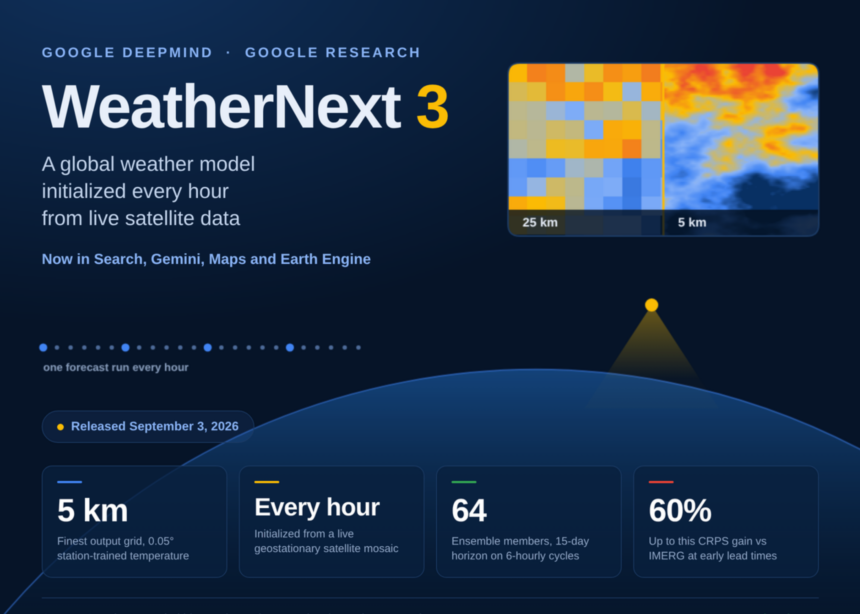
Google DeepMind and Google Research have addressed these limitations with the release of WeatherNext 3. This update marks a departure from standard reanalysis-dependent training, shifting toward a more granular, real-time approach that incorporates live geostationary satellite imagery and raw weather station data to produce high-resolution, frequently refreshed global forecasts.
Core Architectural Advancements
WeatherNext 3 utilizes a Functional Generative Network (FGN), employing a mesh transformer architecture designed to handle multi-resolution outputs. Unlike its predecessor, which relied heavily on standard ECMWF HRES analysis, this model integrates a live global geostationary satellite mosaic as a primary input. By bypassing the traditional six-hour data lag associated with NWP analysis, the system achieves an hourly refresh rate, allowing it to adapt much faster to rapidly evolving meteorological conditions.
Furthermore, the training process represents a significant technical shift. Instead of training solely on coarse reanalysis grids, WeatherNext 3 employs dedicated observational heads that learn directly from raw weather station measurements. This ensures that the model’s outputs—specifically at the 0.05° resolution—are calibrated to ground-truth instrumental data rather than being smoothed representations of the atmosphere.
Forecast Resolution and Output Tiers
A single forward pass of the model generates three distinct output tiers, providing a flexible range of data from granular local observations to broader atmospheric fields:
| Tier | Resolution | Key Variables |
|---|---|---|
| High-Resolution | 0.05° (~5 km) | 2m Temperature, Dew Point |
| Surface Gridded | 0.1° (~10 km) | 10m/100m Wind, Pressure, Cloud Layers, Solar Radiation, Precipitation |
| Atmospheric | 0.25° (~25 km) | 13 Pressure Levels |
By moving from the 0.25° output of WeatherNext 2 to a 0.05° station-trained output, the model provides approximately five times the spatial detail for critical variables, specifically benefiting local forecasting where terrain features like valleys and coastlines significantly impact results.
Operational Performance: Precipitation and Renewables
The model’s approach to precipitation addresses the common AI tendency to smear rain data into diffuse, inaccurate blobs. By training against a multi-modal dataset—combining ECMWF reanalysis, NASA’s IMERG, and Google’s own proprietary satellite-radar reanalysis—WeatherNext 3 maintains sharper, more distinct convective bands. Internal Google evaluations report significant improvements in Continuous Ranked Probability Score (CRPS) metrics:
- vs. IMERG (Early lead times): Up to 60% CRPS improvement.
- vs. MRMS baselines: Up to 30% CRPS improvement.
- vs. Rain Gauges: Up to 10% CRPS improvement.
This precision is particularly impactful for clean energy grid management. By outputting 100 m wind speeds (approximate turbine hub height) and comprehensive solar irradiance (SSRD/FDIR) alongside cloud distribution data, the model provides an integrated solution for operators balancing wind and solar supply against fluctuating demand.
Summary of Key Features
- Data Freshness: Hourly initialization from live satellite data minimizes systemic data lag.
- Probabilistic Forecasting: Operates as a 64-member ensemble, providing critical uncertainty bounds.
- Temporal Coverage: 15-day outlooks for synoptic cycles; 48-hour outlooks for hourly interim runs.
- Accessibility: Available to researchers and operators via BigQuery, Earth Engine, and Google Cloud Storage (requires allowlist request).
While WeatherNext 3 represents a significant leap forward in operational AI meteorology, it is important to note that the model weights currently remain proprietary, and the system is not open-source.