
The Evolution of Multivariate Forecasting
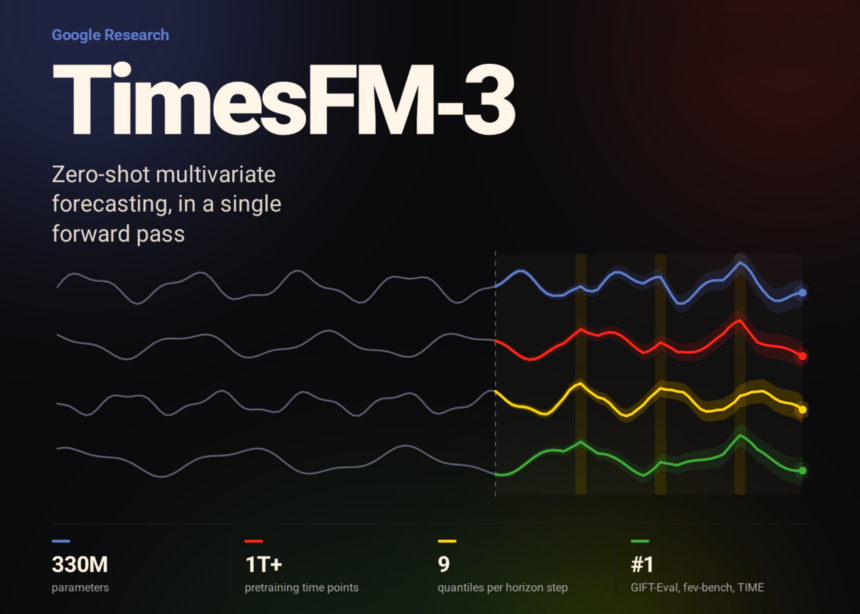
In the landscape of time series analysis, the industry has long wrestled with the limitations of univariate models. Previously, foundation models like earlier versions of TimesFM were constrained to analyzing a single stream of data at a time, often struggling to capture the complex, hidden relationships that define real-world environments. With the release of TimesFM-3, Google Research has shifted the paradigm by introducing a 330 million parameter model architected specifically to handle multivariate relationships natively.
By pretraining on a massive corpus exceeding 1 trillion time points, this new foundation model transcends the “one-series-at-a-time” limitation. It is designed to perform zero-shot forecasting—meaning no task-specific fine-tuning is required—across multiple related time series, allowing it to ingest targets, past covariates, and past-future covariates simultaneously.
Innovative Architectural Shifts
The core capability of TimesFM-3 lies in its sophisticated, two-dimensional approach to attention. The architecture processes time series data by first partitioning them into patches of 32 steps. These patches are then normalized, a crucial step that ensures the model can handle diverse data scales without allowing high-magnitude series to disproportionately influence the forecasting outcome.
Once tokenized, the data is projected onto a 2D grid, where the model applies two distinct, alternating attention mechanisms:
- Causal Temporal Attention: Operates horizontally across the time axis. It is strictly constrained to prevent information leakage by ensuring that tokens only attend to past values within their specific series.
- Full Variate Attention: Operates vertically. At any given time interval, this mechanism evaluates all series concurrently, effectively learning the correlations and dependencies that exist between different variables in the multivariate set.
Efficiency Through Contiguous Patch Masking
A significant performance bottleneck in previous generations was the need to decode patches sequentially. TimesFM-3 addresses this by adopting Contiguous Patch Masking. Instead of generating the forecast step-by-step or patch-by-patch, the model appends masked placeholders for the entire future horizon. Through the alternating attention layers, it solves for these masked values in a single forward pass. At each step, it outputs nine distinct quantiles, covering the 10th through the 90th percentile, providing a robust probabilistic outlook.
Performance at a Glance
TimesFM-3 has been rigorously evaluated against competing architectures like Chronos-2 and the Toto 2.0 family. The findings demonstrate that the model occupies the top average rank among all current foundation models across several critical benchmarks.
| Benchmark Suite | Primary Metric | TimesFM-3 Rank |
|---|---|---|
| fev-bench | 100 Real-World Tasks | #1 Overall |
| TIME Leaderboard | 50 Domains / 98 Tasks | #1 Overall |
| GIFT-Eval | Foundation Model Comparison | #1 (Pretrained) |
Deployment Considerations
While the architectural advancements of TimesFM-3 are substantial, users should note the licensing constraints. The codebase itself is released under the Apache-2.0 license, providing transparency and accessibility for research. However, the specific TimesFM 3.0 weights are governed by the timesfm-non-commercial-license-v1.0. Consequently, while it is a powerful tool for benchmarking and internal analysis, it is restricted from commercial use or deployment behind production-facing APIs. For organizations requiring a production-ready solution under permissive licensing, previous versions like TimesFM 2.5 remain the standard path.
Conclusion
TimesFM-3 represents a leap forward for multivariate time series forecasting. By abandoning autoregressive, sequential generation in favor of a single-pass, masked attention approach, it achieves higher accuracy and lower latency for complex forecasting tasks. It provides a blueprint for how future foundation models will balance cross-variate correlations with temporal consistency.