
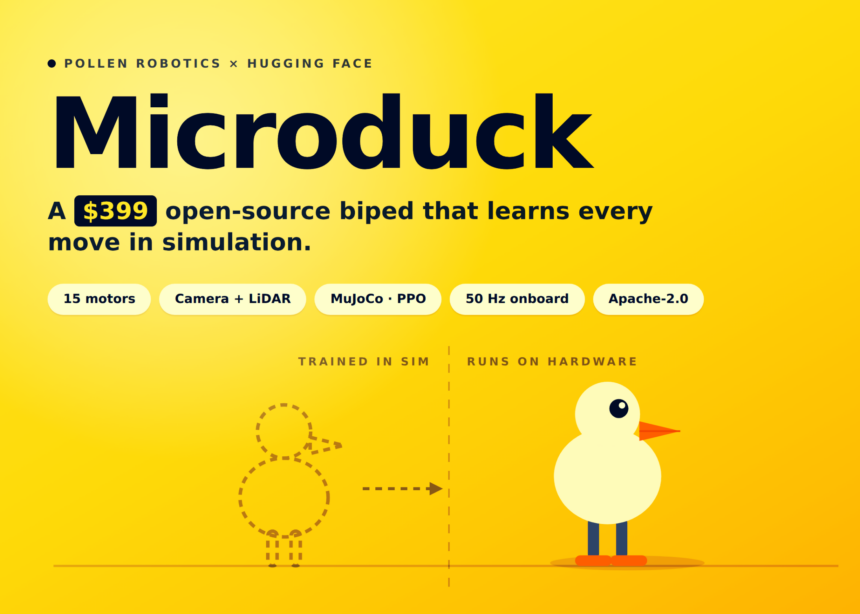
Robotics development has long been plagued by a disconnect between high-level promises and the harsh realities of hardware implementation. Often, enthusiasts are left to decipher vague demonstration videos, wondering if the underlying technology can truly handle the complexities of real-world physics. Pollen Robotics, a division of the engineering team at Hugging Face, is attempting to bridge this divide with the introduction of Microduck, a 25 cm, $399 bipedal robot designed to make advanced reinforcement learning (RL) accessible to developers.
The Architectural Shift: From Desktop Interaction to Locomotion
Microduck departs from the design philosophy of its predecessor, the Reachy Mini, which prioritized static desk-based interaction. Instead, the Microduck is engineered for active movement, agility, and fall-recovery. Its compact frame, weighing under 800 grams and standing 25 centimeters tall, houses 15 specialized motors and a sophisticated array of sensors designed for real-world navigation.
The core philosophy of this project is the democratization of the training loop. Unlike closed systems, Microduck is supported by a comprehensive public repository. Every movement—from walking and kicking to more complex behaviors like roller-skating—is a result of neural policies trained within a high-fidelity physics simulator and subsequently exported to the hardware.
Core Hardware Specifications
- Dimensions & Weight: 25 cm height, 14 cm width, less than 800 g mass.
- Actuation: 15 internal motors across the neck, head, and limbs.
- Compute: Rockchip RK3566 processor featuring an integrated AI accelerator, 1 GB RAM, and 32 GB internal storage.
- Sensory Array: Front-facing camera, dual IMUs (integrated into both body and head), compact LiDAR (8×8 time-of-flight), plus integrated audio and NFC connectivity.
- Power: Removable 2600 mAh NP-F550 battery providing approximately 60 minutes of operation.
Sim-to-Real: The Training Pipeline
The engineering team has prioritized the sim-to-real challenge by focusing on the actuator model. Rather than relying on simplified, idealized PD controllers, they utilized the BAM M6 model for the Dynamixel XL330 servos. This includes complex parameters such as back-EMF, voltage control laws, and load-dependent friction (Coulomb and Stribeck). This nuance is vital for bridging the gap between simulation and the unpredictable physical world.
Training happens within the microduck_rl framework, which leverages the mjlab (MuJoCo Warp) architecture. Utilizing PPO (Proximal Policy Optimization), a usable gait can typically be established in one to two hours using 4096 parallel environments on a CUDA-enabled GPU. For those without local high-performance compute, the training loop is optimized to run seamlessly on Hugging Face Jobs.
Advanced Domain Randomization
The resilience of the robot is built upon aggressive domain randomization. During the training phase, the simulator injects variability into key physical and electrical factors to ensure the resulting policy is robust. This includes randomized battery voltage, voltage sag profiles, command latency, and friction coefficients.
Crucially, the team incorporates gear backlash into the training phase—simulating ±1° of play per servo joint, totaling 2° across the linkage. Because the internal encoders reside on the output side of this mechanical play, the neural network learns to compensate for this slack, which is a major contributor to stability in bipedal systems.
Deployment and Runtime
The policies are exported to ONNX format, with the observation normalization logic baked directly into the graph. This encapsulation prevents the common pitfall of deploying hand-converted checkpoints that lack the correct data scaling. On the hardware side, a lightweight Rust runtime manages the 50 Hz control loop and the motor bus. This architecture utilizes a shared 61-dimensional observation contract (comprising 48 proprioception dimensions and commands for twist, head pose, and body pose), allowing the robot to perform hot-swaps between different trained behaviors during execution.
Summary of Key Features
| Feature | Specification |
|---|---|
| Base Price | $399 |
| Release Target | Orders open August 27, 2026; delivery before end of year |
| Number of Servos | 15 |
| Runtime | ~1 Hour |
| Training Time | 1-2 Hours (4096 parallel environments) |
| License | Apache-2.0 (Software only) |
While the mechanical and electronic design files remain proprietary, the release of the training environments, reward functions, and the complete sim-to-real recipe on GitHub provides a massive leap forward for researchers interested in physical AI, without the high barrier to entry typically associated with advanced bipedal robotics.