
A New Approach to Glucose Modeling
Google Research and the University of New South Wales have unveiled GlucoFM, an innovative foundation model designed to advance continuous glucose monitoring (CGM). Instead of relying on the traditional, monolithic approach—which treats glucose data as a single, uniform sequence—GlucoFM introduces a dual-stream architecture. This design recognizes that glucose traces contain both slow-moving physiological baselines and rapid, transient fluctuations caused by meals, physical activity, or stress. By decomposing these signals, the model gains a more nuanced understanding of metabolic health than previous methods.
Architectural Innovations
The GlucoFM framework functions by mapping CGM recordings onto a standardized 24-hour grid, represented by 288 distinct time steps. Crucially, it respects the non-continuous nature of real-world CGM data by utilizing an explicit observation mask. This ensures the model treats missing or corrupted sensor readings as unknown, rather than forcing artificial imputations that could degrade the model’s accuracy.
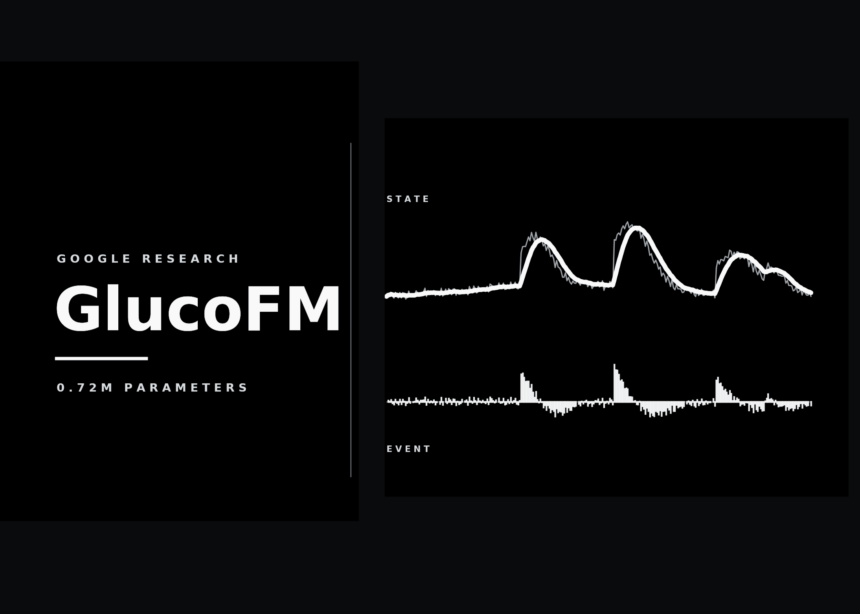
The core of the architecture is a causal, mask-aware Gaussian filter. This component separates the input data into two distinct streams:
- The State Stream: A low-frequency signal capturing the long-term glycemic baseline.
- The Event Stream: A high-frequency, masked residual signal capturing transient metabolic responses.
By pretraining on 109,066 hours of unlabeled data from 477 diverse subjects, the model optimizes these representations using JEPA-style latent objectives. This efficiency allows the model to remain incredibly lightweight, utilizing only 0.72 million trainable parameters.
Performance Benchmarks
GlucoFM demonstrates significant improvements over existing models in both general and CGM-specific metrics. Through extensive testing across four cohorts and seven distinct tasks, the model achieved a task-averaged PR-AUC of 58.8, outperforming both specialized CGM baselines and much larger, general-purpose time-series models.
| Model | Parameter Count | PR-AUC (Avg) |
|---|---|---|
| GlucoFM | 0.72M | 58.8 |
| MantisV2 | 4.2M | 56.9 |
| CGM-JEPA | 0.52M | 54.7 |
| CGMformer | 0.85M | 54.1 |
| GluFormer (Base) | 135M | 52.3 |
Clinical Implications and Deployment
While the results are compelling, it is essential to emphasize that GlucoFM is a research prototype. It has not received regulatory approval and is not currently authorized for medical diagnosis or clinical treatment. The researchers have committed to releasing the source code and reproducibility scripts to the community, enabling further validation and research.
The model’s design makes it highly practical for future integration. Its small footprint—only 0.72M parameters—means that once finalized, it can feasibly run within resource-constrained environments, such as on-device applications or edge containers, providing near-real-time metabolic insights without the need for massive cloud infrastructure.
Key Takeaways
- Dual-Stream Efficiency: By separating state and event streams, GlucoFM avoids the limitations of treating CGM data as a single entangled signal.
- Efficiency and Scale: Despite having a parameter count significantly smaller than many state-of-the-art models, it achieves superior performance across critical tasks.
- Clinical Utility: The model shows the most promising gains in identifying complex metabolic indicators like insulin resistance and beta-cell dysfunction.
- Open Research: Future releases will prioritize code and reproducibility, allowing the broader research community to build upon this architecture.