
The Shift to Local Inference Routing
As multi-agent workflows evolve, the bottleneck for AI performance is shifting from compute power to efficient task distribution. Modern agentic systems operate by decomposing a complex primary request into dozens of smaller, independent model calls. When these calls are directed toward a single local machine, they queue up, leading to idle hardware elsewhere on the network and increased latency. NVIDIA’s newly released Personal AI Router (PAIR) addresses this inefficiency by intelligently scheduling these independent inference requests across a distributed pool of hardware.
PAIR is not an inference engine in itself. It operates as a virtual router, functioning as a bridge that connects existing frameworks like Ollama and LM Studio. By managing requests at the local network level, it ensures that your workstation, high-end server, and Mac nodes operate as a cohesive compute fabric rather than isolated silos.
How PAIR Orchestrates Local Compute
Architecturally, PAIR is designed for ease of deployment. It functions as a proxy that intercepts requests typically sent to a single node and reroutes them based on real-time hardware status. Key operational pillars include:
- Automated Discovery: Using mDNS, PAIR scans your local network for compatible hardware, automatically adding nodes to your cluster.
- Secure Pairing: Trust is established via a six-digit PIN system, ensuring that only authorized nodes participate in the pool. Communications are locked down using mTLS with auto-generated certificates.
- Request-Level Concurrency: PAIR treats each inference request as an atomic unit. It assigns the entire task to a chosen node, where it executes from start to finish. It does not shard a single request across multiple GPUs.
The Scheduling Intelligence
The scheduler determines the ideal placement for every inference request by analyzing five core telemetry signals. For a node to be eligible, it must first be online and have the specified engine and model already loaded. Once eligibility is confirmed, the scheduler evaluates:
- Current Engine Job Load: Assessing how many tasks are already waiting for that engine.
- Node-Level Concurrency: Measuring how many requests are currently being processed by the node.
- GPU Utilization: Monitoring the hardware’s overhead to ensure requests are routed to the system with the most available bandwidth.
Performance Gains: A Case Study
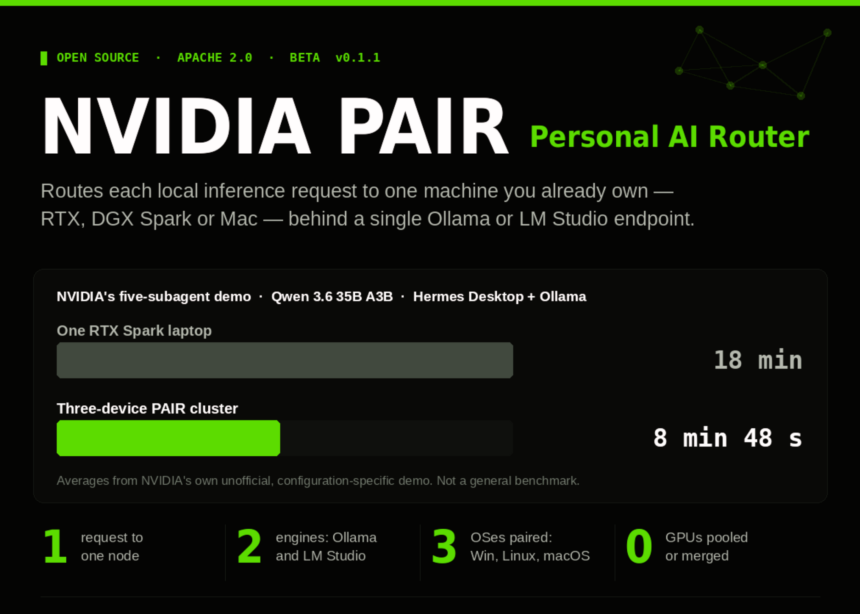
NVIDIA’s benchmark highlights the drastic improvement that distribution provides over single-node bottlenecks. In a standard workflow involving five concurrent subagent requests executing Qwen 3.6 35B A3B models, the time-to-completion drops significantly when leveraging distributed nodes.
| Configuration | Average Completion Time |
|---|---|
| Single RTX Spark Laptop | 18:00 |
| Distributed Cluster (RTX Spark + DGX Spark + RTX 5090) | 08:48 |
Platform Requirements and Availability
PAIR is currently available as a public beta (v0.1.1) and is distributed under the Apache 2.0 license. The hardware support is broad, spanning various architectures to ensure that most modern local environments can participate.
- GPUs: GeForce RTX 20 Series and newer; RTX PRO workstation cards (Turing architecture and newer).
- Compute Units: DGX Spark systems.
- Apple Silicon: M4 chips and newer.
- OS Compatibility: Windows, macOS, and Linux are fully supported (with experimental support for Windows on ARM).
PAIR represents a significant step forward for developers who want to maximize their existing hardware investments without migrating their agent harnesses to the cloud. By decoupling the agent’s request from the physical execution hardware, NVIDIA has created a path for a truly scalable, private, and high-performance local AI infrastructure.