
Bridging the Privacy Gap in Agentic Workflows
Modern agentic AI systems often face an intractable conflict: the very data that makes an assistant effective—such as legal drafts, financial models, or sensitive client documentation—is the data users are most hesitant to expose to cloud-based LLM APIs. Perplexity has introduced a novel solution on macOS that aims to resolve this tension by abandoning the traditional “all-or-nothing” approach to compute location.
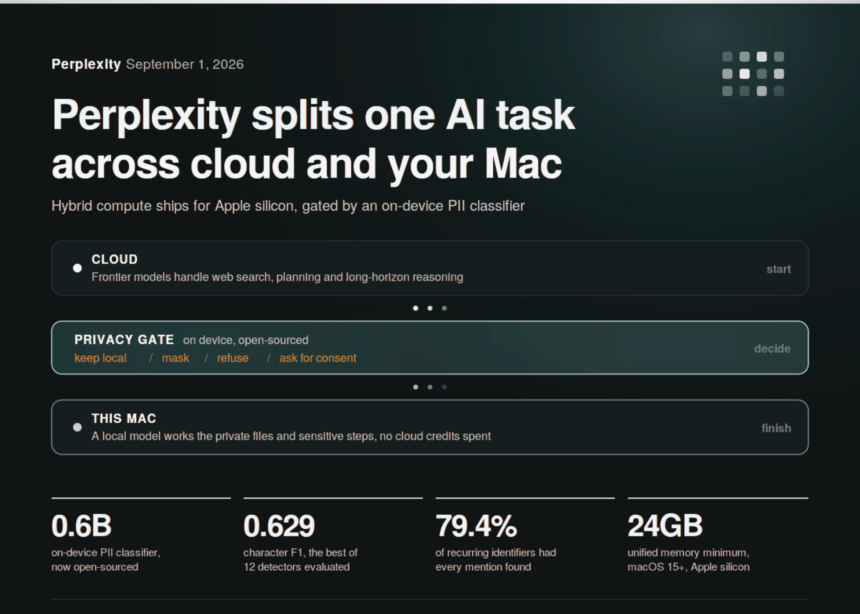
The new architecture, which Perplexity refers to as Hybrid Compute, treats the user’s Mac as a first-class compute node. By orchestrating a seamless handoff between cloud-based frontier models and a locally running model, the system ensures that sensitive processing remains within the hardware’s trust boundary while maintaining the cognitive firepower of cloud-native reasoning.
The Architectural Shift: Orchestration at the Boundary
The design philosophy here pivots on the direction of execution. Unlike previous iterations that might start locally and escalate to the cloud, this system initializes every task in the cloud. The cloud-native agent is responsible for high-level planning, web search, and reasoning. When a specific sub-task necessitates interaction with a protected file or a sensitive local process, the system dynamically reroutes that segment to the local hardware.
Crucially, this is not a disconnected process. The orchestrator maintains the conversational context, effectively splitting a single logical task into two physical streams. The results from the local model are then merged back into the cloud stream, presenting a unified response to the user.
The Privacy Gate: Intelligent Traffic Control
The system relies on an on-device classifier, PII-Tracer, to act as the primary filter. This lightweight 0.6B parameter model—a bidirectional encoder built on a Qwen3 backbone—evaluates data before it is authorized for any egress from the local machine.
The classifier is capable of four primary responses:
- Keep Local: Data is handled entirely by the local model.
- Mask: The system identifies sensitive information and replaces it with placeholders before the remaining text is sent to the cloud.
- Refuse: The specific action is blocked for violating safety constraints.
- User Consent: The user is prompted to manually approve or deny the action.
Benchmark Performance and Consistency
Perplexity’s testing demonstrates that finding PII in massive, multi-turn conversations is a distinct challenge compared to analyzing a single snippet. The PII-Tracer model emphasizes consistency over single-pass recall.
| Detector | Character F1 Score | Consistent Mention Finding (Cross-turn) |
|---|---|---|
| PII-Tracer (0.6B) | 0.629 | 77.6% |
| GPT-5.6-sol | 0.584 | 55.1% |
| GLiNER2-PII | 0.210 | — |
An interesting technical detail is the mitigation of context degradation. While raw character-level recall for long-context windows (exceeding 10,000 characters) historically suffered, the implementation of sliding-window decoding with a 50% overlap improved total character recall from 0.830 to 0.965.
System Requirements and Implementation
Hybrid compute is currently available for Pro, Max, and Enterprise users. To ensure a performant local experience, the architecture has strict hardware requirements:
- Platform: macOS 15 or later.
- Hardware: Any Mac utilizing Apple silicon.
- Memory: 24GB of unified memory (32GB recommended).
For large organizations, the system offers administrative controls that allow IT teams to define granular rules for data egress, providing a audit trail for when and why data is handled locally versus in the cloud.