
Revolutionizing Document Parsing with Reducto r-1
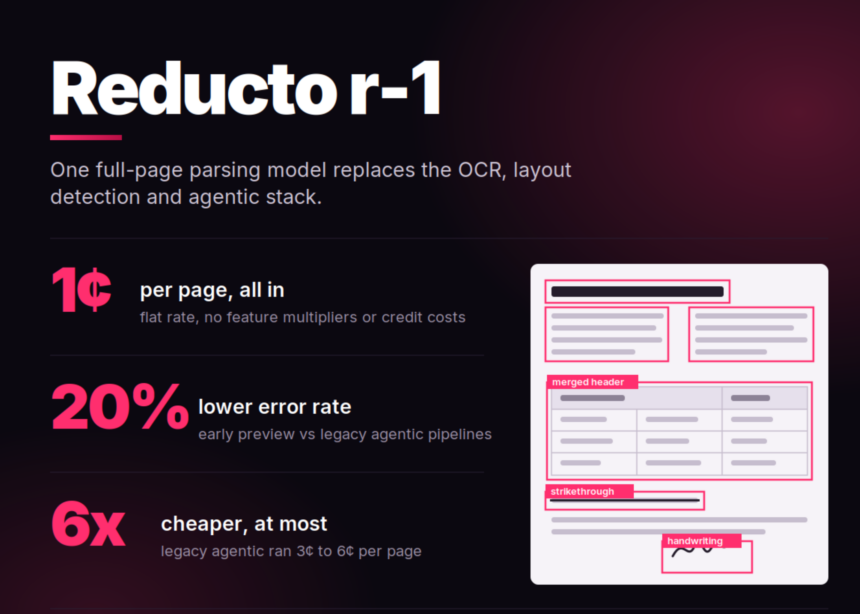
Document processing has long been hindered by the complexity of multi-stage pipelines. Traditionally, extracting structured data from documents involved a fragile chain of OCR, layout analysis, and post-processing, often requiring additional heavy-lifting from large language models to correct errors. Reducto has fundamentally changed this approach with the release of r-1, an innovative model architecture that replaces these disconnected pipelines with a single-pass inference process.
Beyond the Pipeline: The Architectural Shift
The traditional parsing stack is prone to error accumulation at each stage. By the time a document is converted from raw pixels to structured output, latency has ballooned, and the initial layout context is often lost. Reducto’s r-1 architecture abandons this fragmented workflow by performing text recognition, table structuring, figure detection, formatting analysis, and reading order resolution simultaneously in one full-page pass.
A major benefit of this consolidated approach is the native integration of grounding. Because the model resolves all document elements in a single pass, it generates page-relative bounding boxes for every entity, effectively tying the output directly to the original document structure without requiring secondary mapping layers.
Performance and Economic Impact
Reducto’s internal evaluations indicate that r-1 provides a 20% reduction in error rates compared to their previous agentic pipelines. By eliminating the overhead of running multiple specialized models in sequence, the system achieves significantly higher efficiency.
The pricing model has also been simplified to move away from complex, variable-cost workflows toward a flat, predictable rate:
| Model Generation | Pricing Strategy | Cost per Page |
|---|---|---|
| Legacy Agentic | Variable (Workload dependent) | 3 to 6 cents |
| r-1 Model | Flat rate | 1 cent |
Implementation and Deployment
The r-1 model is currently available in preview through Reducto’s Parse API (V3). To switch from legacy processing, developers need only update their API call configuration. It is important to note that the model is fully hosted, with no public weights available for self-hosting.
To implement the r-1 model, use the following API configuration snippet:
result = client.parse.run(
    input=upload.file_id,
    settings={"model": "r-1"}
)
Critical Nuances for Regulated Workflows
While r-1 is designed to handle a vast array of document types—from low-quality scans to complex financial tables—some specialized tasks still require the agentic engine. If your application necessitates highly custom prompts or extremely granular chart extraction, the system can dynamically route these specific pages through Reducto’s agentic pipeline, which is then augmented with r-1’s foundational parsing results.
For organizations moving from other providers, Reducto is currently offering a migration credit program to facilitate comparative evaluations. This allows teams to benchmark r-1 against incumbent solutions like Amazon Textract or Azure Document Intelligence to determine if the architectural shift aligns with their accuracy and latency requirements.
- Unified Processing: One pass handles text, tables, figures, and formatting.
- Precision Grounding: Native page-relative bounding boxes for all extracted data.
- Simplified Costs: A flat fee of 1 cent per page replaces the previous tiered pricing structure.
- Compatibility: r-1 is enabled via the V3 API; legacy pipelines remain available for specific edge cases.