
The End of Local Model Configuration Headaches
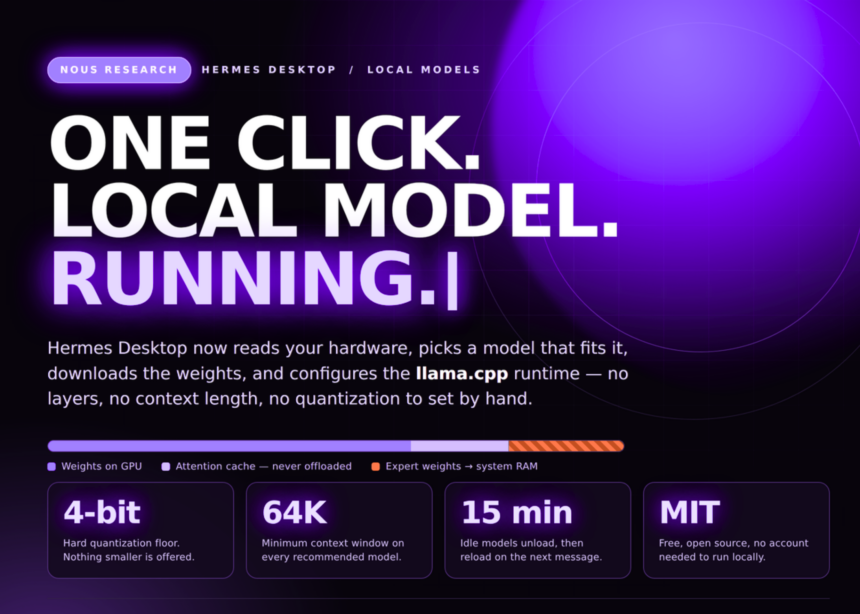
For developers who prefer working with local models, the primary barrier has never been the quality of the model itself. Instead, the friction lies in the deployment process: auditing hardware, calculating available VRAM, determining the correct quantization level, and fine-tuning context windows, only to discover at runtime that the model footprint exceeds your hardware limits. Nous Research has finally addressed this technical hurdle by integrating a fully automated, one-click setup flow into Hermes Desktop.
Architecture of the One-Click Flow
The new setup mechanism acts as an intelligent orchestrator. Upon the first launch—or when manually triggered via Settings → Providers → Local Models—the application executes a hardware handshake. It evaluates your machine’s specifications, including VRAM and system memory, to curate a selection of models that will run performantly.
Hermes manages the underlying llama.cpp infrastructure, fetching an optimized build tailored specifically to your hardware architecture (CUDA, Metal, Vulkan, HIP, or CPU). By centralizing this runtime management, the application handles complex variables such as GPU layer offloading and inference engine versioning without user intervention. The resulting configuration is persisted in the local_runtime block of the config.yaml, maintaining transparency for power users who need to perform manual headless overrides.
The Intelligence Behind Model Selection
Hermes employs a strictly enforced heuristic for model placement, ensuring that users receive a stable experience regardless of their hardware tier:
- Qualification: Every available model is checked against your specific machine specs. Models that exceed your hardware capacity are clearly marked with the reason for their incompatibility, providing clear feedback on exactly what hardware upgrades would be required.
- Quantization Strategy: The engine selects the highest-quality quantization that can be fully contained within your GPU VRAM.
- Quality Floor: Nous Research has set a hard limit at 4-bit quantization. If a model cannot fit into your GPU without spilling to system RAM at this minimum quality level, it is flagged as incompatible to prevent severe performance degradation.
Memory Management and Runtime Stability
Effective local inference relies on precise memory orchestration. Hermes avoids common pitfalls by enforcing a specific offloading hierarchy when demand exceeds local VRAM capacity. The system prioritizes the retention of the attention cache within the GPU to maintain performance, offloading expert weights to system RAM only when strictly necessary. Furthermore, Hermes ensures that recommended models always start with a guaranteed 64K context window, adjusting the window dynamically based on actual memory overhead during operation. Idle models are automatically offloaded after 15 minutes of inactivity and restored upon the next prompt request.
Key Operational Features
- Automated Provisioning: Instant hardware detection and runtime configuration for llama.cpp.
- Zero-Account Dependency: The desktop client is completely free and requires no cloud-based authentication for local model execution.
- Cross-Platform Consistency: The setup logic is unified across macOS 12+, Windows 10/11, and Linux environments.
- Intelligent Offloading: Context-protected offload sequences that prevent model stalling during high-memory utilization.