
The New Standard for Commerce Agent Development
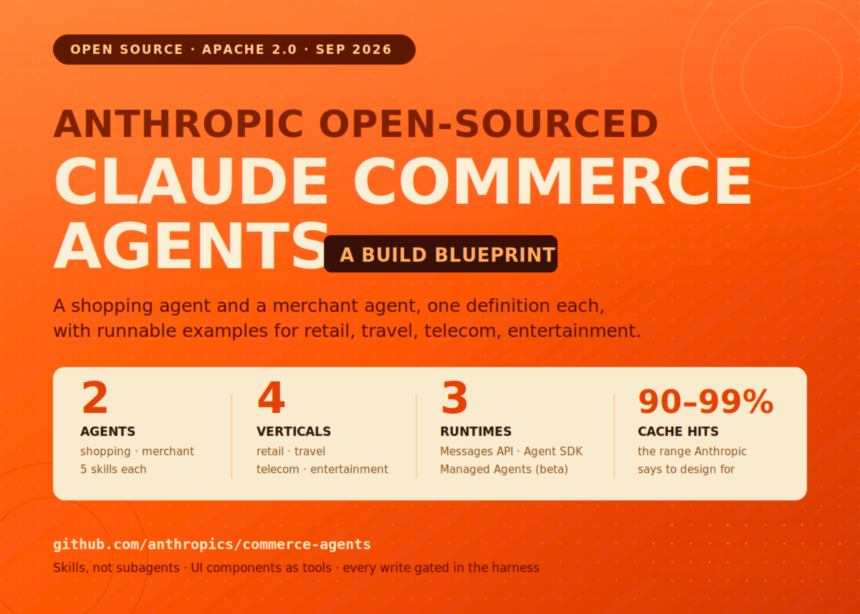
In the rapidly evolving field of agentic AI, the industry has suffered from a recurrent problem: every engineering team building a commerce-focused agent ends up building the exact same boilerplate architecture. From custom agent loops and complex tool-to-catalog mappings to rigorous approval gates and evaluation suites, this redundant effort slows down innovation. To address this, Anthropic has released Claude Commerce Agents, an Apache-2.0 licensed reference architecture designed to standardize how businesses approach shopping and merchant automation.
This release provides a production-ready blueprint that includes both a consumer-facing shopping agent and an internal merchant support agent. By providing these as open-source components, Anthropic allows organizations to shift their focus from building basic infrastructure to fine-tuning domain-specific logic.
Core Architectural Pillars
The blueprint offers a flexible runtime environment that can be deployed locally using Python or Node.js. Because it relies on standard client interfaces, it is entirely cloud-agnostic, allowing developers to switch seamlessly between models served via Amazon Bedrock, Google Cloud Vertex AI, Microsoft Azure, or direct API access. The architecture is built on five key principles:
- Unified Agent Loops: The design rejects the common tendency to build a separate intent router or a fragmented system of subagents. Instead, it utilizes a single, tightly coupled agent loop.
- Skill-Based Modularity: By utilizing agent skills rather than distinct subagents, the architecture avoids the performance and state-management tax often associated with complex handoffs.
- Typed UI Components: User interface elements are treated as tools rather than prose generation. When an agent needs to present a product, itinerary, or comparison, it calls a typed tool, ensuring the application backend handles rendering cleanly.
- Safety through Harnessing: Sensitive actions—such as processing payments or finalizing orders—are never decided by the model itself. The model proposes, while the application harness enforces business logic, inventory caps, and authorization gates.
- High-Efficiency Prompt Caching: The system is structured to maximize prompt caching, ordering data from static global configuration to highly volatile session state to minimize token costs and latency.
Agent Capabilities
The reference architecture distinguishes clearly between the consumer and staff workflows:
| Agent Type | Primary Objectives | Key Tooling |
|---|---|---|
| Shopping Agent | Catalog discovery, multi-item cart management, returns, and order tracking. | Search-discovery, purchase-research, personalization, and customer care. |
| Merchant Agent | Inventory monitoring, pricing strategies, and sales performance analytics. | Performance insights, catalog management, promo drafting, and inventory ops. |
Addressing Latency and Token Efficiency
A critical focus of the documentation is the management of perceived latency. Anthropic argues that the 500-700 output tokens required for a rich commerce response can create frustrating delays if not handled correctly. The blueprint demonstrates eager tool dispatch, where the system executes tool calls as soon as their arguments are fully streamed, rather than waiting for the entire response to complete. This dramatically improves the time-to-first-pixel.
Furthermore, prompt caching is vital for economic viability. Anthropic’s benchmarks indicate that properly structured prompts—where volatile data like timestamps are placed last—can achieve hit rates between 90% and 99%. This efficiency allows cached reads to operate at roughly one-tenth the cost of fresh tokens while reducing latency for large prompts by nearly half.
Platform Selection and Implementation
For organizations looking to deploy these agents, the choice of provider remains open. The architecture allows teams to move between providers to optimize for specific cost or model-performance constraints. Anthropic also includes a Claude Code plugin, commerce-builder, which simplifies the process of scaffolding new agents or auditing existing configurations against the established best practices. By standardizing these patterns, the Claude Commerce Agents blueprint provides a robust foundation for building resilient, high-quality, and secure commerce automation.