
A New Benchmark in Multimodal Reasoning
Z.ai has officially launched GLM-5.3-Flash, representing a significant shift in the GLM-5 series. This model stands out as a natively multimodal Mixture-of-Experts (MoE) system designed to balance high-level coding performance with aggressive cost optimization. By leveraging a sparse architecture, it delivers exceptional reasoning capabilities at a fraction of the cost previously seen in the series.
Under the Hood: Architectural Innovation
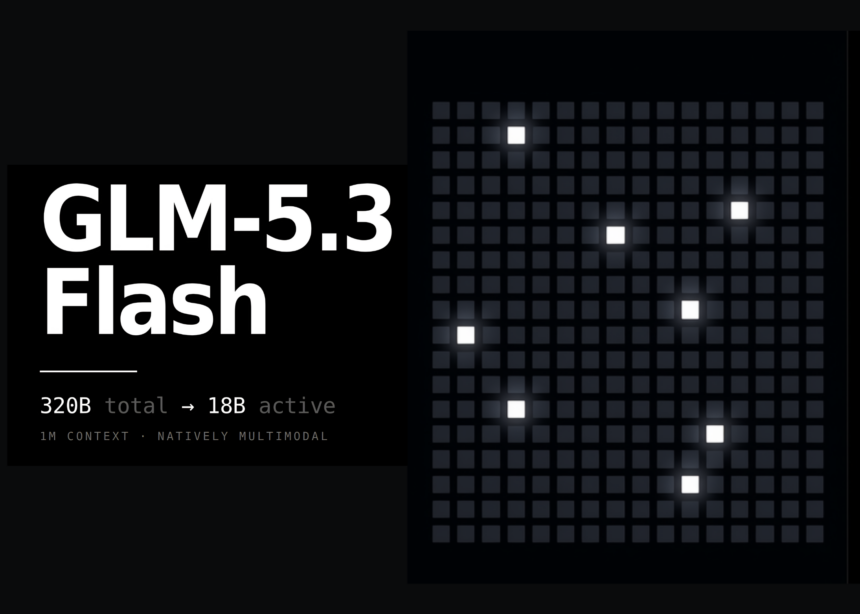
The model architecture is built on a massive 320B parameter count, yet it maintains high efficiency through a sparse routing mechanism. When processing tokens, only 18B parameters are active, which explains how it achieves such competitive latency and throughput. The system is built on a 30T-token multimodal dataset, integrating both visual and video input streams.
Two critical architectural features drive its performance:
- Hybrid Attention Mechanism: For the first time, this model interleaves KDA linear-attention layers with NoPE sparse MLA layers. This duality allows the model to manage local dependencies with high efficiency while using sparse retrieval to pull in relevant global context.
- IndexPool Compression: To make the 1M-token context window practical, Z.ai introduced IndexPool, a technique that compresses key vector groups. This leads to a massive reduction in memory overhead, specifically a 4.4x smaller KV cache and 3x less attention compute compared to its predecessor.
Performance and Benchmark Metrics
While benchmarks often vary based on setup, the reported metrics position GLM-5.3-Flash as a highly competitive tool for complex coding and analytical tasks, rivaling established models like Claude Opus 4.8.
| Benchmark Task | GLM-5.3-Flash Score | Comparison Reference |
|---|---|---|
| Terminal-Bench 2.1 | 84.3 | Opus 4.8 (85.0) |
| DeepSWE v1.1 | 63.4 | GLM-5.2 (46.2) |
| AutomationBench | 48.8 | GLM-5.2 (26.2) |
| OfficeQA Pro | 62.4 | Outperforms Opus 4.8 |
| Z.ai Code Bench v1.0 (max) | 29.0 | Opus 4.8 (29.5) |
Deployment, Pricing, and Accessibility
Z.ai has provided two distinct pathways for utilizing the model. The full FP8 checkpoint is available on Hugging Face under an MIT license, though it requires significant hardware, typically an 8-GPU node, for local self-hosting. For most organizations, the API route offers the most economic advantage.
API Pricing:
- Input: $0.15 per million tokens ($0.03/M with caching).
- Output: $0.50 per million tokens.
Beyond the cost savings, the model is fully integrated into the ZCode ecosystem, with expanded quotas for existing subscribers. Its native multimodal support allows for advanced applications such as automated UI regression testing, repository-scale coding agents, and complex document analysis without the need for additional OCR pipelines.