
Unlocking Extreme Context Scaling with DeepSeek-V4.1-Flash
As LLM-driven agents increasingly tackle long-horizon reasoning tasks, the memory demands of serving models have reached a critical bottleneck. The primary culprit is the Key-Value (KV) cache, which grows linearly with the sequence length, consuming massive amounts of GPU memory and bandwidth. DeepSeek AI has addressed this challenge with the launch of DeepSeek-V4.1-Flash, a sophisticated multimodal Mixture-of-Experts (MoE) architecture explicitly engineered to slash memory overhead while maintaining high performance.
Architectural Innovations for Efficient Memory
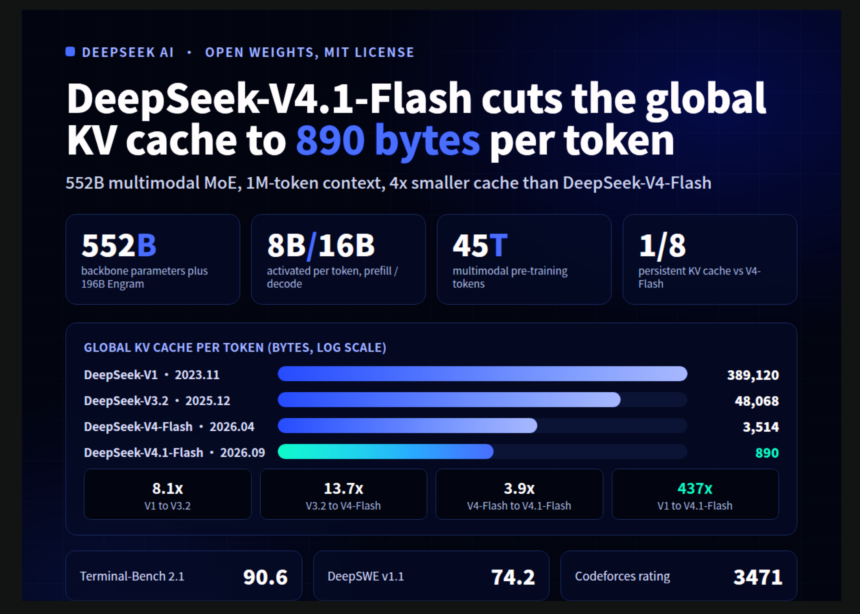
DeepSeek-V4.1-Flash introduces a 552B parameter backbone, supplemented by 196B Engram parameters, and supports a massive 1M-token context window. To handle this, the team re-architected how the model manages KV storage and prefill computation. The model achieves a global KV cache footprint of just 890 bytes per token, representing a staggering 437x reduction compared to the original DeepSeek-V1 and a 4x improvement over the previous V4-Flash iteration.
Causal Encoder-Decoder (CED) Efficiency
The 40-layer model is partitioned into two distinct halves: a 20-layer causal encoder and a 20-layer decoder. This design, influenced by the YOCO research architecture, ensures that the decoder does not need to compute its own global KV cache. Instead, it derives the cache from the final encoder hidden state using per-layer projections. By stopping prompt processing at the encoder, the model effectively eliminates the computational cost of re-processing the prompt for the decoder, significantly accelerating prefill speeds.
Compressed Sparse Attention 2 (CSA2)
To further manage the context window, DeepSeek-V4.1-Flash utilizes CSA2, which categorizes layers into three specialized modes to optimize memory reuse:
- Full Mode: Computes the main KV and indexer K afresh, selecting new Top-512 indices.
- Reindex Mode: Leverages the main KV and indexer K from the last Full layer but performs new scoring with a local indexer Q.
- Reuse Mode: Directly reuses both the main KV and the Top-K indices from an earlier layer, completely bypassing the expensive indexing compute.
Performance Benchmarks
DeepSeek-V4.1-Flash demonstrates that massive scale does not necessarily require massive activation. During prefill, it activates 8B parameters per token, increasing to 16B parameters during the decoding phase. Below is a comparison of its performance across several critical reasoning and automation benchmarks:
| Benchmark | DS-V4.1-Flash | DS-V4-Flash | Opus-5 | GPT-5.6 Sol |
|---|---|---|---|---|
| Terminal-Bench 2.1 | 90.6 | 82.7 | 89.1 | 88.8 |
| DeepSWE v1.1 | 74.2 | 54.4 | 74.0 | 73.0 |
| Terminal-Bench 4.0 | 31.2 | 7.0 | 51.8 | 39.9 |
| Automation-Bench | 54.8 | 37.7 | 50.3 | 45.8 |
| GPQA Diamond | 90.9 | 89.9 | 93.4 | 94.1 |
| Codeforces (rating) | 3471 | 3289 | n/a | n/a |
Deployment and Infrastructure
DeepSeek-V4.1-Flash is designed for real-world production environments. The model’s weights are available under an MIT license, supporting standard inference paths such as vLLM, SGLang, and Hugging Face Transformers. Additionally, the developers have implemented FP4 quantization for the main KV cache, which reduces storage requirements by nearly 50% compared to previous FP8 implementations. The infrastructure is further bolstered by a distributed SWA KV cache pool, which utilizes host DRAM to prevent SSD-based cache latency, ensuring the model remains highly responsive even at 1M-token context lengths.