
A Technical Deep Dive into Qwen3.8-Flash-Next: Efficiency at Scale
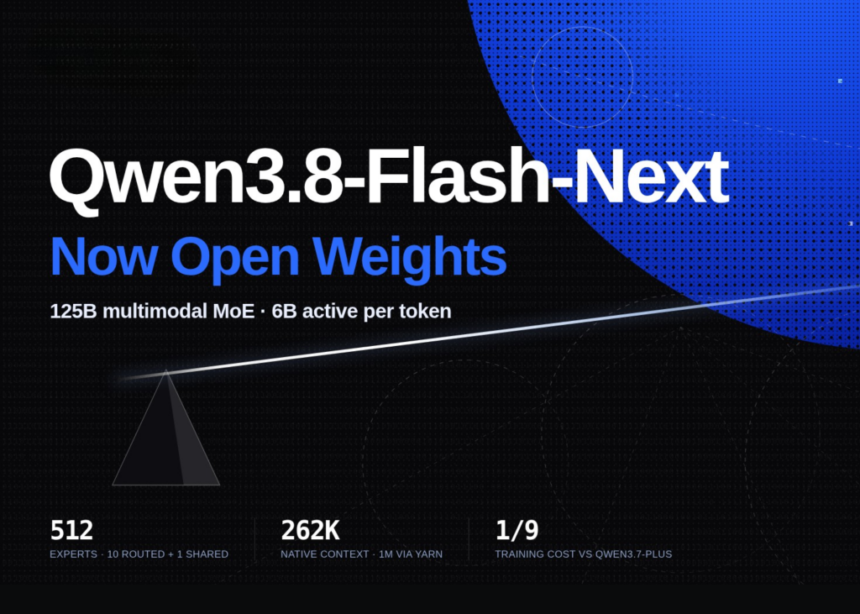
The landscape of large-scale multimodal models has just shifted with the release of Qwen3.8-Flash-Next by the Alibaba Qwen team. Positioned as a direct evolution of the underlying architecture that will eventually power Qwen4, this model is a calculated experiment in maximizing performance per token. By pairing a substantial 125B parameter backbone with advanced architectural optimizations, the team has delivered a model that, despite its massive disk footprint, operates with the compute intensity of a far smaller unit.
Architectural Innovations: Balancing Power and Compute
The core philosophy behind Qwen3.8-Flash-Next is the decoupling of model capacity from active inference compute. While the model is hefty at 180B parameters total—comprising the 125B backbone, 51B for N-gram embeddings, and a 4B module for multi-token prediction—it only activates 6B parameters per generated token. This is achieved through a multi-faceted architectural approach:
- Hybrid Attention (GDN + QSA): The model utilizes a layer-wise strategy where 75% of the architecture relies on Gated DeltaNet (GDN), a linear-attention mechanism that efficiently compresses temporal history. The remaining 25% employs Qwen Sparse Attention (QSA), which dynamically selects context at a micro-block level, drastically reducing the overhead typically associated with long-context windows.
- Gated Residuals: By replacing standard residual connections with a four-branch gated system, the model achieves finer control over signal flow, utilizing bottleneck rank 320 to maintain high-fidelity updates without bloating the parameter count.
- Deterministic N-gram Embeddings: A specialized 20-million-entry table handles bigram and trigram lookups at layer 2. This offloads significant semantic capacity to a static lookup table that incurs almost zero additional compute cost during inference.
- Muon Optimization: The adoption of the Muon optimizer alongside traditional AdamW has allowed for more aggressive scaling laws and more efficient training cycles, reportedly achieving performance milestones at just one-ninth the training cost of the Qwen3.7-Plus iteration.
Deployment Realities
It is crucial to understand that this is not a model destined for local workstation execution. The memory requirements are significant, with the BF16 checkpoint requiring 335.28 GiB and the FP8 version demanding 172.78 GiB of VRAM. For optimal deployment, the Qwen team recommends a tensor-parallel configuration of at least TP4 on high-end hardware like the H200, as plain TP8 is incompatible with the specific 128-wide quantization blocks found in this checkpoint.
| Checkpoint Format | Disk Footprint | Recommended Configuration |
|---|---|---|
| BF16 | 335.28 GiB | TP4 (Minimum) |
| FP8 | 172.78 GiB | TP2 (Minimum on GB300) |
Performance and Efficiency
The model displays a refined balance between raw reasoning capabilities and operational efficiency. In benchmarks, it exhibits high proficiency in complex coding and reasoning tasks, though it remains slightly behind frontier models like Claude Opus 4.6 in specific reasoning-heavy benchmarks. The primary value proposition lies in its serving efficiency, with vendor-reported prefill throughput improvements significantly outstripping its predecessors when operating with a high prefix-cache hit rate.
For developers, the model integrates seamlessly into modern inference stacks including vLLM and SGLang, and fine-tuning remains accessible through standard ecosystem tools like LLaMA-Factory and Unsloth. As with all community-licensed models, practitioners should carefully review the usage terms of the qwen-community-1.0 license before integrating it into production enterprise environments.